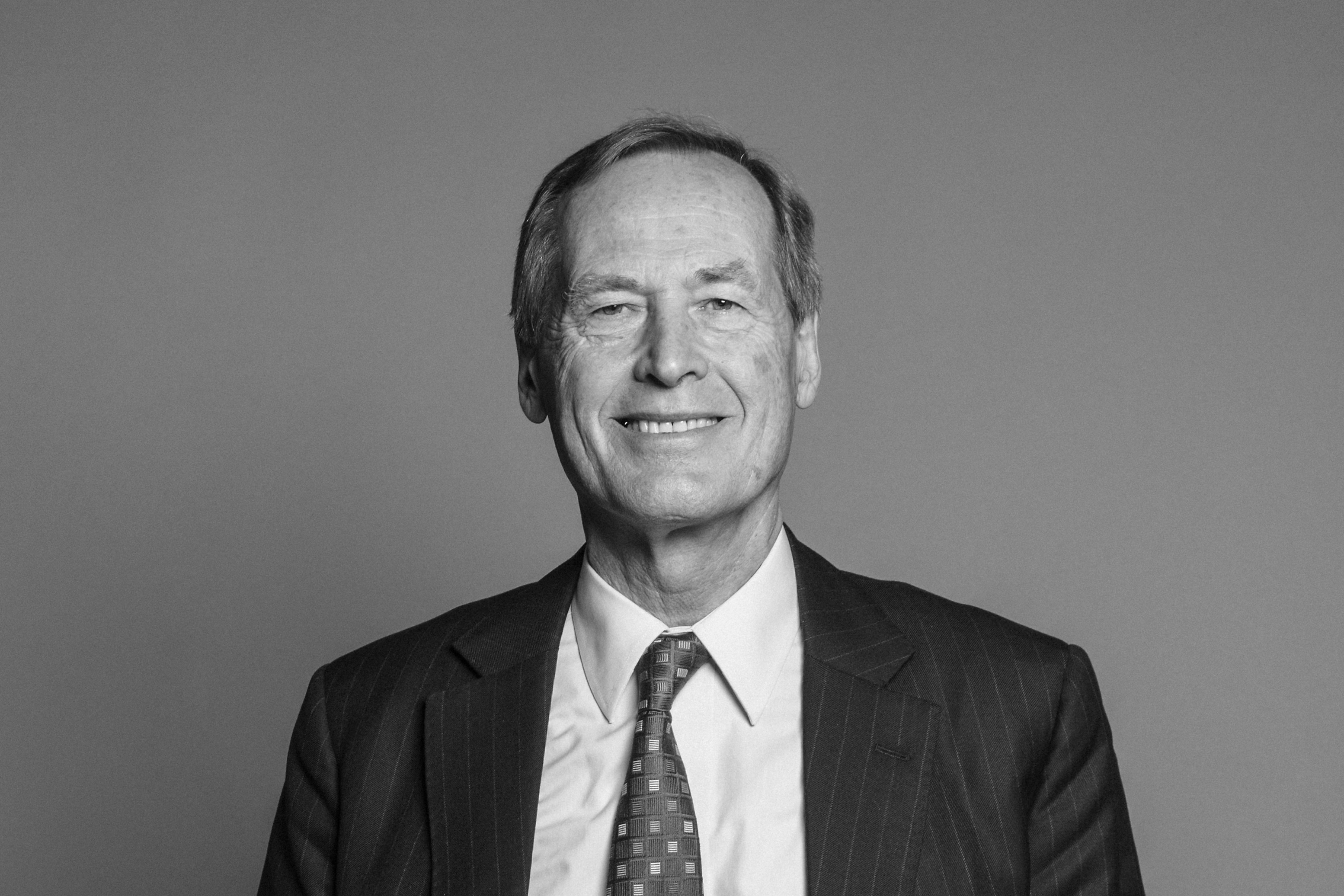
In Memory of Lord Howarth
The trustees and staff of the National Centre for Creative Health (NCCH) are deeply saddened by the death of The Right Honourable, Lord Howarth of Newport CBE, our President and founding Chair. Lord Howarth was an inspirational leader of the creative health movement for over 25 years since his time as Minister for the Arts from 1998-2001. Following his distinguished tenure as NCCH’s inaugural Chair, Lord Howarth stood down on 19th July 2024 to become President of the NCCH. He continued to support the organisation as an advocate for creative health until he passed away on 10th September 2025.
In the last year before his death, Alan wrote a personal and political memoir, Begun, Continued: A Personal and Political Memoir, chronicling fifty years of politics and activism which he had been engaged during his lifetime. This Memoir is now available as an eBook or as a Paperbook Edition.
The speech below is adapted from a thank you from Alex Coulter (Director of NCCH) to Lord Howarth of Newport at the NCCH board awayday in July 2024, when he stepped down as Chair of the organisation and became Honorary President. Find out more about Lord Howarth's inspirational leadership and contribution to creative health >>
Written by Alex Coulter, Director of NCCH
I met Alan in the autumn of 2012 when I was planning the first Culture, Health and Wellbeing international conference, to be held in Bristol in June 2013. I was introduced to him by Damian Hebron, Gavin Clayton and Clive Parkinson, stalwarts of the arts and health field, who had been involved in national developments in the previous few years. We were all part of a nascent National Alliance for Arts, Health and Wellbeing. Alan had been interested in this field at least since his time as Minister for Education in 1997 and then with more focus once he became Minister for the Arts in 1998. It was the perfect time to forge ties between the Department for Culture, Media and Sport and the Department of Health, in the context of the large scale new hospital building programme under Blair. Alan initiated joint working between the two departments and although they were too late to influence the first round of PFI-funded hospitals, Alan, always passionate about architecture and design, was instrumental in ensuring that high quality architecture was a strong consideration in the design of the new hospitals going forward. He helped create the Commission for Architecture and the Built Environment (CABE) which was an executive non-departmental body of the government, established in 1999, and which continued until 2010 to influence and support good urban design and high quality public spaces.
In 2005 Alan was created a life peer and from his position in the House of Lords he continued to advocate for the benefits of the arts and creativity for health and wellbeing. Between 2005 and 2008 there were significant developments at a national level resulting in A Prospectus for Arts and Health, published jointly by the Department of Health and Arts Council England. You can read here Clive Parkinson's recollections of Alan and a meeting he attended with the Secretary of State for Health, Alan Johnson, in 2007. Alan played a pivotal role in securing a speech by Alan Johnson in the Wallace Collection in September 2008, where he referenced how museums and galleries can help address social exclusion; the therapeutic value of the arts in hospital environments; and the benefits of involvement in the arts for those experiencing mental ill-health or at risk of it, and said: ‘this is not some kind of eccentric add-on – it should be part of the mainstream in both health and social care’ and that the NHS needed to transform from: ‘a service that’s excellent at recognising illness and treating it, to one that can more successfully prevent illness and promote health and wellbeing.’
After that high-point, many of us working in the field found ourselves dipping our heads below the parapet during the 2008 financial crisis and the turmoil that followed. By the time of the 2013 Culture, Health and Wellbeing international conference, we were beginning to gather our forces again, in no small part galvanised by Alan’s brilliant leadership. His keynote speech at the conference is still referenced by friends and colleagues who were there. It gave us a sense of hope and collective purpose and in Alan we had someone who could champion our cause and seemed to really understand the challenges and the value of the work. He inspired us by placing it in the context of a much larger vision. To quote that speech: ‘We are at a moment when western societies face an existential choice. Your mission to mobilise the arts in the service of health and wellbeing symbolizes and illuminates that choice. Are we, in our society and in our public services, to embrace the values of creativity, humanity, empathy and reciprocity? Or are we to continue with the barrenness of materialism, competitive self-seeking, anomie and bureaucratic crassness?’
He proposed setting up an All-Party Parliamentary Group on Arts, Health and Wellbeing, the APPG, which he would chair, and asked us, the National Alliance for Arts, Health and Wellbeing, to provide the secretariat. Through my role as Director of Arts and Health South West, I had the capacity to help. Alan invited Dr Sarah Wollaston, then a Devon MP, and Paul Burstow MP, a former Minister for Care Services, to become officers of the group which launched in 2014.
The APPG decided to ‘carry out an Inquiry into existing engagement of the arts in health and social care, with a view to making recommendations to improve policy and practice’, to quote Alan’s Foreword in the Inquiry Report, published in 2017. It was a great privilege to be witness to and part of the 16 roundtables we hosted in parliament. There were extraordinary moments, often when people with lived experience spoke to the gathered academics, practitioners and policy makers. The relationships we made and the networks that developed have held us in great stead and form the basis for much of our work now.
The 2017 report ‘Creative Health: The Arts for Health and Wellbeing’ has had quite a remarkable impact. I could never have anticipated the range of its influence. I think most people working in the field of, what is more often than not now referred to as ‘Creative Health’ would cite the inquiry and report as the most significant development in the last 15 years.
In response to Recommendation 1 in the report, we went on to establish the National Centre for Creative Health in 2020, with Alan as our founding Chair and with the support of Professor Helen Chatterjee and Bill Boa as founding trustees. Alan continued to chair the organisation until July 2024 and was the driving force behind the Creative Health Review which the NCCH delivered in partnership with the All-Party Parliamentary Group on Arts, Health and Wellbeing in 2022-2023. This built on the recommendations in the 2017 report to once again ask the government to develop a cross-departmental Creative Health Strategy; that HM Treasury should allocate appropriate resources to support the Creative Health Strategy; and that lived experience experts should be integral to its development. In December 2024, we re-launched the All-Party Group as the APPG on Creative Health, with Dr Simon Opher as the Chair and Alan as Vice-Chair. He continued to advocate for creative health with ministers in the new Labour Government and attended and spoke at APPG meetings online.
It was with great sadness that I heard of Alan's death on September 10th 2025. He has been a remarkable leader, guide, friend and ally over many years and I will miss him very much.