Refugees, Migrants & Asylum Seekers as ‘New Citizens’: Home, Identity & Belonging in increasingly fractured circumstances
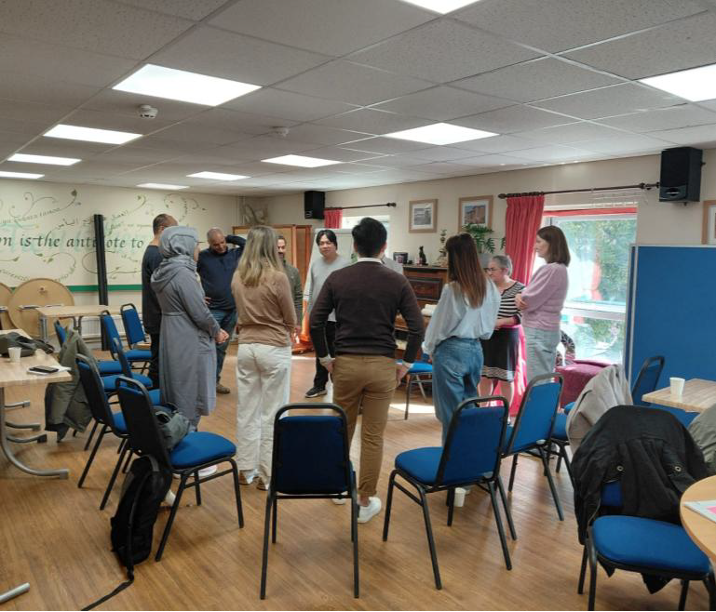
On Tuesday 14 October 2025, two Mobilising Community Assets projects – REALITIES led by Marisa de Andrade and MigRefHealth led by Margaret Greenfields – gathered for a knowledge exchange workshop which focused on the diverse experiences of refugees, migrants and asylum seekers, at a time when discourse around their lives in the UK is becoming increasingly crude and vitriolic.
Presentation #1: Leah Soweid and Deborah McArthur for REALITIES
The first presentation brought refugees, migrants and asylum seekers’ experiences to the fore by sharing ‘hyper local testimonies’ that helped draw a more nuanced picture of the very complex experiences of refugees, migrants and asylum seekers in Scotland, and drew attention to the fact that – despite the lack of nuance in media and political discourse – those experiences are neither homogenous nor interchangeable :
- Belonging and exclusion: testimonies recounted difficulties with finding a sense of belonging in their neighbourhoods – being made to feel hyper-visible and ‘other’ despite having lived in their area for a long time; or, experiencing daily hostility (e.g. being ignored by bus drivers at the bus stop even when they raise their hand to request a stop).
- Assumptions: testimonies also gave insight into the sort of assumptions they face (e.g. being mistaken for an asylum seeker when you’re an economic migrant), highlighting the fact there is no such thing as looking your identity.
- The inadequacy of categories: commonly used labels such as BAME don’t always make sense to the people they intend to represent/refer to, and they could sometimes be taken advantage of by people who aren’t BAME.
- Language barriers: bringing family over to the UK when they speak little to no English can sometimes lead to difficulties, esp. with the elderly and access to health services.
- Identity in flux: testimonies pointed out the complexity of building a cohesive sense of identity after completing the family reunification process and being reunited with family the UK.
- The re-traumatising impact of having to constantly retell your story.
Presentation #2: Margaret Greenfields for MigRefHealth
The second presentation delved into the core ways MigRefHealth delivers one of its project aims – namely, ‘to make sure that community assets used by local communities are collaboratively identified and better supported to help improve the health outcomes for refugee, asylum-seeking and migrant communities’ – and mapped out the project’s research findings so far. MigRefHealth seeks to produce asset maps for refugees, asylum seekers and migrants in each of their field sites’ areas in order to provide ‘a central platform to help identify some of the health and support resources for refugees, asylum seekers, and migrants in the local area’.
Food & Nutrition
- Food plays a fundamental part in the experience of refugees, asylum seekers and migrants in the UK, nurturing a sense of nostalgia and providing emotional comfort.
- Refugees, asylum seekers and migrants do often have concerns about the cost and quality of the food available to them, especially in relation to children’s nutrition and ensuring children get the best food possible.
- Refugees, asylum seekers and migrants are willing to travel far to find the right food, which are not always readily available in their local areas, in supermarkets or specialist retailers. But this can be problematic because of the expense of travel, or where there are very limited public transport options available.
Accommodation
- Ease of access to accommodation varies depending on status/route of entry.
- Accommodation types include social housing, private housing, or hotels/group accommodation – but such accommodation is not readily accessible and available - e.g. social housing comes with strenuous processes & long waiting times; depending on their status, refugees, asylum seekers and migrants can’t always meet private housing criteria (annual income, guarantors, etc.), and each come with different sets of concerns (properties often too small, overcrowding, health and safety issues like mould; poor maintenance, lack of privacy; lack of appropriate cooking facilities or food storage in communal accommodation; concerns over safety of some locations)
- Building social networks in temporary housing and being moved - often at very short notice - can often cause a lot of pain and have adverse effects on mental health and wellbeing
Services
- There are many barriers to accessible use of services – e.g., digital exclusion, language barriers, lack of knowledge; barriers to employment based on legal status;
- And those barriers are sometimes compounded by hostility and bias from staff or co-workers.
- Lack of flexibility and compassion: being told there is no other option when expressing concerns about living in certain areas while being visibly ‘different’.
- Legal aid can often be slow or approved at the last minute and, therefore, is often inadequate.
- Refugees, migrants and asylum seekers do seem to report more positive experiences in health services, with health professionals credited with going the extra mile, and the advantage of often being able to find caregivers who speak your language.
Presentation #3: Oksana Fomenko for MigRefHealth
This was followed by a presentation by MigRefHealth community co-researcher Oksana Fomenko. Drawing upon her work with MigRefHealth as a researcher through the prism of her own lived experience coming to the UK from Ukraine, Oksana highlighted:
- The importance of language: speaking English is a skill which helped facilitate a more seamless integration and helped overcome issues connected to access to advice and services and/or health services.
- Homes for Ukraine played a fundamental part in helping Ukrainian refugees learn to speak English. Not only does it provide an immediate network and support; but it also gives refugees and their children access to Universal Credit, provides support with education, and enables them to learn English free of charge.
- Living with British host families helped make integration smoother.
- ‘Community is the greatest asset’: having Ukrainians who have lived in the country for a long(er) time as anchor points in their local community gave Ukrainian refugees access to a wealth of knowledge and information about schools, social clubs, mental health services, and other support.
Discussion:
The discussion gave other MCA Phase 3 projects (RomaPlaceAge and Abundance) the opportunity to highlight commonalities in their own projects. It also provided presenters and attendees with the opportunity to further discuss themes outlined in the main presentations (language challenges, etc.). The discussion also touched on:
- The extensive impact of current political discourse and media discourse about refugees, migrants and asylum seekers on local communities and project participants.
- The importance of trust when engaging with local communities.
- The importance of faith-based spaces to share moments of community and solidarity and foster solidarity-based dialogue.
- Discrimination, class and racial bias between refugees, asylum seekers and migrants - they may experience racism and discrimination from local populations, as well as from other refugees, asylum seekers and migrants.
- The duty of a research programme like Mobilising Community Assets to gather as much learning and data as possible to empower other people who want to undertake similar projects.
- The great work already being accomplished locally thanks to the leadership of community partners.
Recording available here:
About MigRefHealth and REALITIES
The MigRefHealth project research involves collaboration between 23 academic and community partners working together to explore how community assets can tackle health inequalities for diverse refugee, asylum seeking and migrant communities across three regions: North London, South London and the East of England. The goal is to make sure that services used by local communities are collaboratively identified and better supported to help improve the health outcomes for refugee, asylum-seeking and migrant communities
REALITIES are a transdisciplinary collective of individuals with lived and felt experience of inequalities working alongside policymakers; local authorities; charities; artists; environmentalists and researchers from policy, to work towards an understanding of what work is needed to enable places to reimagine and build ‘systems’ that create equitable health and wellbeing.
About Mobilising Community Assets
Mobilising Community Assets is a three-phase UK Research and Innovation (UKRI) funded Research Programme running from 2021 to 2027. It is coordinated by the Culture-Nature-Health Research Group at University College London, in partnership with the National Centre for Creative Health (NCCH) and funded by UK Research and Innovation (UKRI), led by Arts and Humanities Research Council (AHRC), with Biotechnology and Biological Sciences Research Council (BBSRC), Economic and Social Research Council (ESRC), Natural Environment Research Council (NERC) Medical Research Council (MRC). Mobilising Community Assets to Tackle Health Inequalities (MCA) has encouraged the projects it has funded throughout the UK to share knowledge and approaches to integration of community assets into the integrated care structures that exist in the local communities.