What do we mean by ‘lived experience’?
Reflections and learning from part way through the Mobilising Community Assets (MCA) programme
Overview written by Chelsea Mac Donnchadha, Danny Sherwood and Celeste Burr-Herrera.
In recent years, there has been a growing emphasis in research on ensuring that lived experience is included in projects and decision-making. While the term ‘lived experience’ is often used, it is rarely defined. This can lead to confusion and potentially friction, making it harder to share learning and establish good practice in involving lived experience. There are many types of lived experience, and many ways it can be applied to research. As we have connected with and learned from the 12 projects funded by the Mobilising Community Assets to Tackle Health Inequalities (MCA) programme, we have developed a better understanding of the diverse ways in which lived experience can be described and included.
The MCA programme is a research programme led by University College London in partnership with the National Centre for Creative Health that aims to explore how collaborative community, cultural and nature-based activities can improve health inequalities in the UK. Co-create came on board to help the MCA team to understand how lived experience is being applied and understood across projects. To do that, we first needed to understand what people across these projects meant when they used the term ‘lived experience’. We brought the project teams together in two creative participatory workshops to discover aspects of lived experience that are shared across projects, and the diversity that enables different types of participation from across different communities.
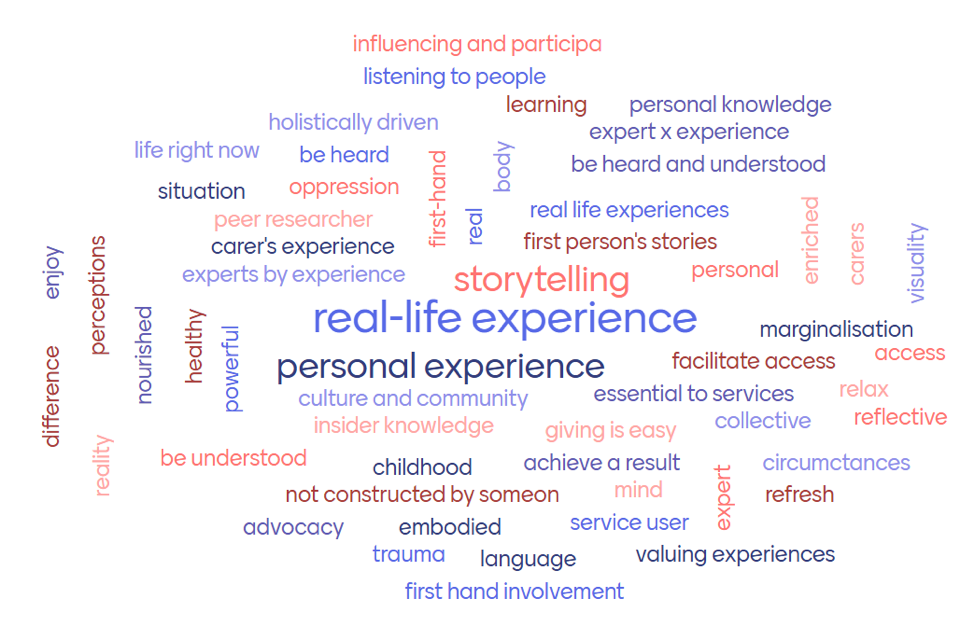
We started our second workshop by asking participants what language they have encountered to describe ‘lived experience’, their responses creating a word cloud.
We found differing views on how useful it is to discuss language around lived experience. Some participants felt that it could be a distraction when there is more pressing work to do, particularly when projects have the potential to bring about significant change. At the same time, language can impact how people with lived experience engage, their experience of engaging, and even whether they engage at all. The terms that different MCA projects use for the roles that people with lived experience play are almost as varied as the projects themselves. There are ‘community voices champions’, ‘community co-researchers’ and ‘lived experience experts’ to name a few. While the majority are happy with the terminology, few reported having the opportunity to co-produce the terms that are used to define their involvement.
A theme noted in several of the projects was a blurred line between academics and people with lived experience working and engaging on projects. When projects are first imagined and developed, academics and people with lived experience can often sit neatly in separate circles. This distinction is how we tend to define the “co-” in terms like co-production or co-design. But in some MCA projects, there is significant crossover between academic experience and lived experience (as there is in Co-create). This was seen as a strength of those projects, but one that was not always anticipated or fully explored. This is something we are keen to understand further.
We heard from participants that lived experience was valued in all the projects, but many also identified barriers and challenges. Some people felt that it would have been better to be involved earlier when the projects were being formed. They identified barriers in academic and funding systems that make early participation difficult. This included delays and difficulties in getting community organisations set up as suppliers, and pastoral support for people with lived experience not having all of the funding it needs.
Teams are working hard to overcome barriers and build structures which support and enable participation, while also advocating for change within their institutions. It was clear that involving lived experience through systems which inadvertently discourage engagement can be challenging and time consuming, but from the value we have seen so far, it is worth it. As we move into the next phase, projects are continuing to think about how they can better share that learning and knowledge both inside and outside of academia and in ways that are accessible to the communities in which they are engaged. We have already seen the creative and innovative ways this is already happening, and how it is continuing to evolve is inspiring.
For the Co-create team, we want to ensure that we support the MCA team and projects to do this in a way that brings to life the similarities and differences, the assertions and contentions without falling into the trap of flattening lived experience into an easily replicable package of engagement. This is a challenge, and one the Co-create team are keen to address. Given the diversity in language and practice around lived experience, how can we work with the MCA team and projects to share accessible guides to working with lived experience without falling into the trap of flattening lived experience into a replicable package? While there isn’t an easy answer, the heartfelt and enlightening work of the MCA projects is providing a rich source of learning, one that we’ll continue to explore and share.
About Mobilising Community Assets to Tackle Health Inequalities (MCA)
Mobilising Community Assets to Tackle Health Inequalities (MCA) programme, MCA is a three-phase UK Research and Innovation (UKRI) funded Research Programme running from 2021 to 2027. It is coordinated by the Culture-Nature-Health Research Group at University College London, in partnership with the National Centre for Creative Health (NCCH) and funded by UK Research and Innovation (UKRI), led by Arts and Humanities Research Council (AHRC), with Biotechnology and Biological Sciences Research Council (BBSRC), Economic and Social Research Council (ESRC), Natural Environment Research Council (NERC) Medical Research Council (MRC). Mobilising Community Assets to Tackle Health Inequalities (MCA) has encourage the projects it has funded throughout the UK to share knowledge and approaches to integration of community assets into the integrated care structures that exist in the local communities.