Working with Artists - A Guide for Health and Social Care Teams to Implement Creative Health Initiatives
Artists bring unique skills, perspectives, and ways of working that can transform health and social care. Whether through music, visual arts, theatre, crafts, or creative writing, artists’ practice can help to open up new ways for people to express themselves, connect with others, and improve their health and wellbeing. For health and social care teams, working with artists offers the chance to build more inclusive and person-centred approaches for creative health initiatives such as projects, activities and research.
This blog is designed to showcase a range of supportive examples to help health and social care professionals understand how to work effectively with artists from commissioning and co-production of these initiatives.
The National Centre for Creative Health (NCCH)’s resources:
NCCH has developed some practical resources to guide health and social care teams through the process of commissioning creative health programmes. The resources help to outline how creative health can help to be a cost-effective and community-based intervention that can support mental health.
Commissioning a creative health programme offers health systems and communities a cost-effective way to improve wellbeing. To build a creative health programme, commissioners may consider understanding local needs and opportunities. Find out more on NCCH’s website here.
The NCCH resource on commissioning creative health in specific health pathways includes the Suffolk and North East Essex Long COVID Service as a case study. Developed by East Suffolk and North Essex NHS Foundation Trust, the service integrates creative health initiatives alongside clinical care. Delivered in partnership with Voluntary, Community and Social Enterprise (VCSE) providers, these interventions have been shown to improve mental health, quality of life, and physical wellbeing for people living with Long COVID. By supporting robust outcome measures with lived experience feedback, this example demonstrates how creative health can be commissioned effectively as part of a clinical pathway offering flexible, person-centred support while tackling health inequalities.
NCCH Creative Health Toolkit
Our Creative Health Toolkit aims to support collaborative work and better health outcomes for commissioners, communities, and individuals. The Toolkit has a dedicated focus on Creative Health In Action which contains a series of checklists as a means to prompt thought around developing and delivering creative health approaches and initiatives.
These checklists include creative health areas such as:
- Creative Health Development: agreeing partnership roles, scope, framework, and referral processes.
- Finding the right creative delivery partner: drafting and circulating a brief, shortlisting and appointing applicants, and supporting induction.
- Supporting delivery and ongoing monitoring: managing delivery, enabling reflective practice and supervision for creative health initiatives. The Creative Health Toolkit can help to ensure creative health interventions are delivered with clarity, care, and sustainability.
Discover more at: https://creativehealthtoolkit.org.uk/creative-health-in-action.
Examples from the Toolkit:
Engaging artists in collaborative networks, such as the Torbay Culture and Arts Network (TCAN), highlights the value of cooperation over competition. Supported by a Paul Hamlyn Foundation programme, TCAN creates a “front door” for commissioning by enabling artists and organisations to pitch joint proposals for health and wellbeing projects. Although unconstituted, the network allows a lead artist or organisation to hold contracts and subcontract collaborators, ensuring a range of skills and art forms could be included for creative health initiatives. This flexible model continues to foster meaningful engagement, giving artists opportunities to contribute their expertise within supportive and cooperative structures.
Example of creative health impact:
Commissioning artists to work directly in schools is opening up new ways to support children’s mental health. To support teaching staff; schools and local authorities are partnering with creative health practitioners and organisations to deliver programmes that weave arts into pastoral care. These collaborations are showing real impact, with schools reporting improved behaviour, attendance and pupil wellbeing as a result of engaging artists in this way.
The London Creative Health City: Building it Together initiative offers a useful example of how this collaboration can be supported in practice.
On its website, the London Creative Health City curates resources to help practitioners, commissioners and cultural freelancers plan, fund, and evaluate creative health projects, activities and research. The Creative Health Connections Map identifies local assets such as practitioners, organisations, heritage spaces, and social prescribing activities while the Creative Health Networks directory helps people meet, share learning, and collaborate. In 2023, the London Arts and Health undertook research for the Greater London Authority (GLA) into the different types of networks supporting the development of creative health practice, policy and research. As a result of that research, they developed a detailed spreadsheet that includes a combination of hyperlocal, regional and pan-London networks on creative health that could be of use to health and social care teams.
London Arts and Health (LAH)’s website supports both artists and health professionals across London and beyond championing excellence in arts and wellbeing. Through its work, LAH promotes collaboration, best practice, and helps extend the reach of the arts to individuals and communities who may benefit most. By connecting culture and health, the organisation plays a vital role in widening access to creative health initiatives and those working in the sector such as creative health artists to support wellbeing.
The site regularly posts opportunities, open calls, workshops, and networks for artists working in health and wellbeing, making it easy for professionals to find creative health practitioners with supportive skills and interests. From socially engaged artists in local communities, to those having creative health workshops with people living with dementia or young people’s mental health projects, LAH provides a directory of opportunities and events that highlight the breadth of practice. By using the website, health and care teams can identify potential creative health collaborators, commission artists, or link into existing networks to embed creative health in their services.
Culture, Health & Wellbeing Alliance (CHWA):
The Culture, Health & Wellbeing Alliance (CHWA) is a free-to-join membership organisation dedicated to advancing creative health across England. With more than 7,000 members from freelance artists to museums, heritage sites, and arts organisations, CHWA works to connect those using culture and creativity to improve health and wellbeing. Based in Barnsley, South Yorkshire, the Alliance plays a vital role in advocacy, research, and collaboration, partnering closely with organisations such as the National Centre for Creative Health, and the Lived Experience Networks. The LENs is a network of people who believe in the benefits of creative and cultural engagement to individual and collective wellbeing.
By amplifying innovative practice, systemic change, and supporting regional peer networks, CHWA helps build a thriving creative health sector and makes the case for culture and creativity as essential to tackling health inequalities and shaping healthier, more connected communities.
The Creative Health Quality Framework (CHQF) is a sector-wide tool that helps to explain a framework for balanced creative and cultural initiatives supporting health and wellbeing. Built around eight Creative Health Quality Principles, the framework provides practical, downloadable resources that guide practitioners, commissioners, and organisations in delivering balanced and impactful creative health projects. Developed by consultant Jane Willis with input from over 200 contributors including creative practitioners, participants, health commissioners, and researchers and funded by Arts Council England, the CHQF helps to support confidence across the creative health sector, support creative practice and highlight its vital role in health and community settings.
Creative Health Residencies, Britten Pears Arts:
The Creative Health Residencies at Britten Pears Arts show how health and social care teams can connect with artists in structured and collaborative ways. By offering mentoring, and opportunities for experimentation, they create a supportive environment where health teams can partner with artists to develop innovative approaches, and build creative health projects that improve wellbeing and tackle health inequalities.
What makes this model distinctive is its commitment to co-production. Artists are encouraged to collaborate with people who have creative health lived experience from the earliest stages of a project, ensuring that the work reflects real needs and perspectives.
The residencies also provide practical support: equipped workspaces, accommodation, meals, travel expenses, and where possible, stipends or mentoring. This infrastructure reduces barriers to participation and enables teams to focus on co-creation. In many cases, the process includes opportunities to share work-in-progress with small audiences, offering valuable feedback and making the creative process itself a point of connection with communities.
Age & Opportunity:
Engaging the arts in creative health within a care home setting starts with recognising the value professional artists bring as specialists in creativity, not as medical professionals. Successful collaboration involves practical planning from ensuring residents and staff are on board, to providing suitable space and deciding whether creative health activities will be project-based or delivered through workshops. Resources such as Age & Opportunity’s toolkit and guideline offer practical advice, while local Arts Offices can help connect care homes with artists and funding opportunities. National and local schemes, including the Arts Council, Creative Ireland, and community grants, provide further support to make creative projects possible. With the right partnerships and resources, the arts can become a meaningful part of everyday care, enhancing wellbeing, fostering inclusion, and enriching the lives of older people.
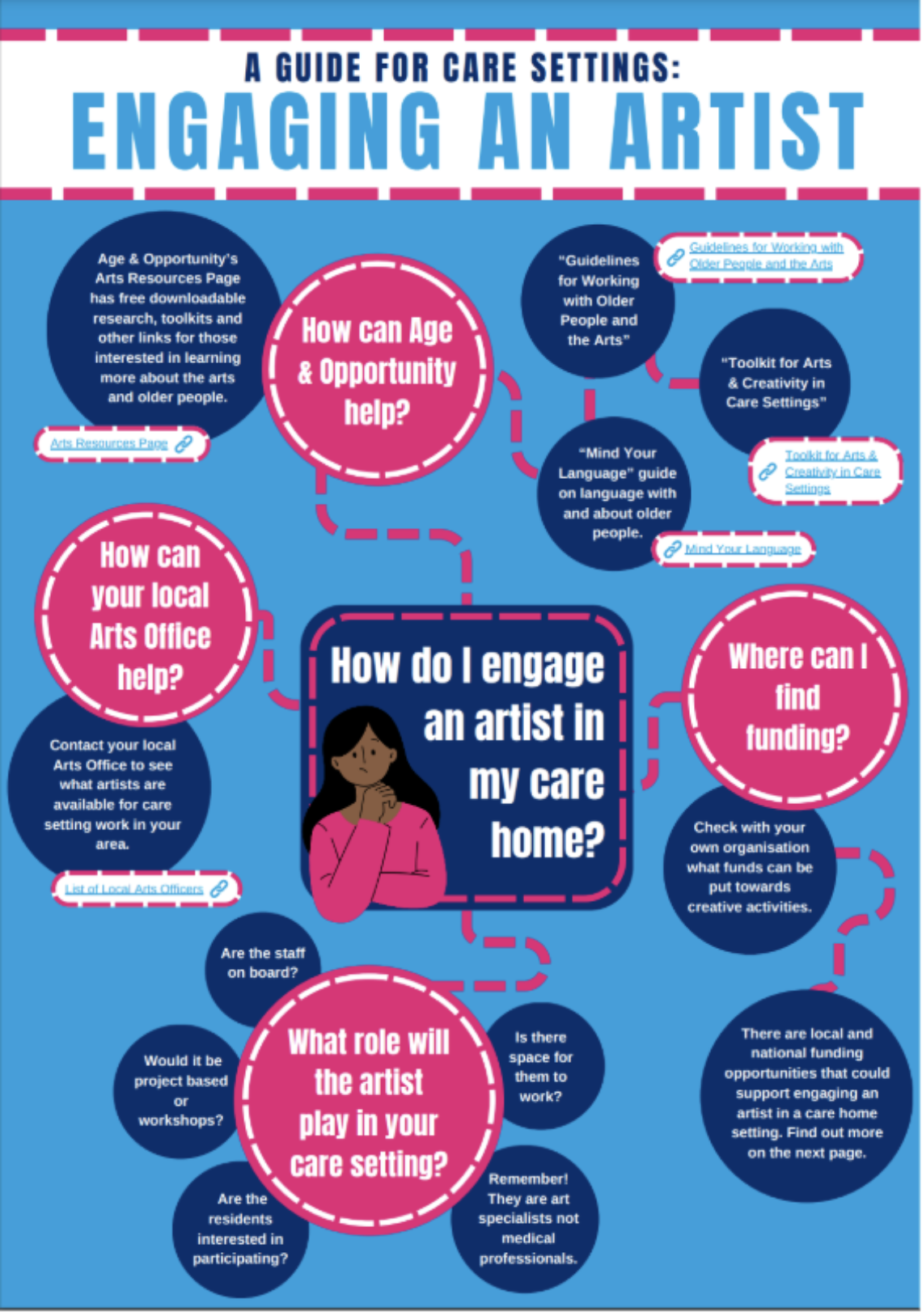
Reference: Infographic: Age & Opportunity Resource - A Guide for Care Settings: Engaging an Artist
Arts & Care:
The Arts in Care programme, launched in 2019 by Luminate, the Care Inspectorate and Creative Scotland with support from the Baring Foundation, has shown the transformative impact of creativity in care settings. Skilled artists work with older people in care homes through visual arts, writing, dance and music, supported by specialist training to ensure person-centred approaches, particularly for residents living with dementia. An independent evaluation by Research Scotland found that the programme not only enriched residents’ daily lives, boosting confidence, interaction, and physical wellbeing, but also empowered care staff to integrate arts into everyday practice. The findings highlight how creative engagement fosters connection, sparks memories, and improves quality of life for both residents and staff.
Health and social care teams can also engage artists by using practical tools like the Arts in Care recipe cards, which translate creative practice into easy-to-follow activities for care settings. Covering artforms such as dance, poetry, singing, printmaking, and salt dough, the cards give staff step-by-step guidance, tips, and variations to run successful creative sessions with residents. Tested in care homes with positive results, they empower staff to bring the benefits of arts into everyday care while also leaving space for innovation through blank cards that teams can adapt and share. By collaborating with artists to co-design and test these activities, care staff gain confidence to embed creativity in their practice, making it a sustainable, shared part of health and care delivery.
The Wales Arts Health & Well-being Network (WAHWN):
The Wales Arts Health & Well-being Network (WAHWN) provides a vital platform for connecting health professionals, commissioners, and creative practitioners across Wales. Each health board has dedicated coordinators responsible for commissioning and supporting arts interventions, making the network a key resource for embedding creative health into healthcare settings from GP surgeries to hospitals. Through its website, WAHWN offers opportunities to share tenders and call-outs, access a members’ directory of creative health practitioners, and explore the Knowledge Bank of research, project reports, and case studies showcasing best practice on creative health. By linking health boards with the arts sector, WAHWN strengthens collaboration and ensures arts and wellbeing initiatives can be more supported and accessible across Wales. The Wales Arts Health & Well-being Network (WAHWN) Creative Health Quality Framework helps to support standards of practice, ensuring that creative health projects are a safe, effective, and equitable for the people and communities they serve.
By building balanced and respectful collaborations, health and social care teams can help to support some of the benefits of creative health and help to deliver some meaningful benefits for individuals and communities through creative health activities.