All in this together?: Community COVID, or how community assets can redress health inequities
Mughal, R., Thomson, L.J. & Chatterjee, H.J. (2024). How can community assets redress health inequities? The pandemic and beyond. In K. Gray & V. Tischler (Eds.), Creative approaches to wellbeing, 15–41, Ch. 2, Manchester: Manchester University Press.
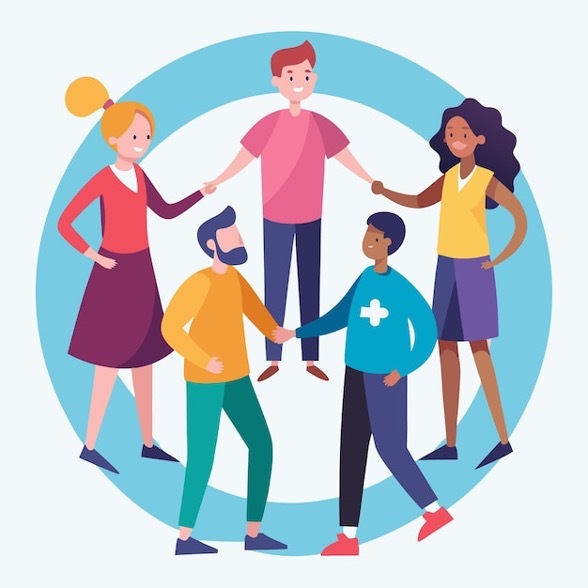
During the COVID-19 pandemic there was an increase in informal mutual aid across different communities while many individuals turned to salutogenic activities – such as art, music, being in nature, physical exercise, spiritual or philosophical reflections. Yet there still appears to be a mismatch between ad-hoc salutogenic engagement and that instigated by statutory services such as social prescribing.
Community COVID was an eighteen-month research project funded by the Arts and Humanities Research Council. The project explored how individuals engaged in salutogenic activities from both a community and systems perspective, with the aim of shedding light on how creative, community and cultural engagement could be used to tackle some of the major social determinants of health such as isolation, digital poverty and inequality.
See full chapter: https://doi.org/10.7765/9781526172600.00002
Resource Output from the Mobilising Community Assets to Tackle Health Inequalities (MCA) Programme
Mobilising Community Assets (MCA) is a three-phase UK Research and Innovation (UKRI) funded Research Programme running from 2021 to 2027. It is coordinated by the Culture-Nature-Health Research Group at University College London, in partnership with the National Centre for Creative Health (NCCH) and funded by UK Research and Innovation (UKRI), led by Arts and Humanities Research Council (AHRC), with Biotechnology and Biological Sciences Research Council (BBSRC), Economic and Social Research Council (ESRC), Natural Environment Research Council (NERC) Medical Research Council (MRC). MCA has encouraged the projects it has funded throughout the UK to share knowledge and approaches to integration of community assets into the integrated care structures that exist in the local communities.