
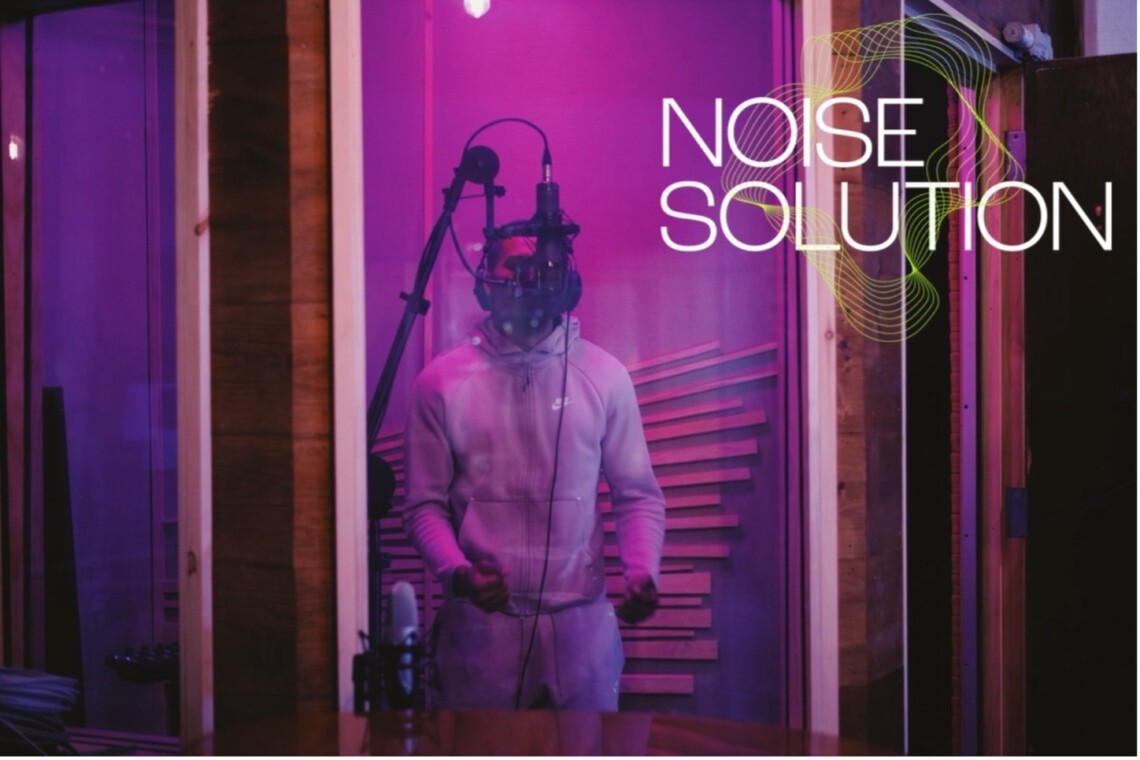
Noise Solution
Delivered by: Noise Solution
In partnership with multiple local authorities, ICB and MAT partners across the East of England
Funding: Mixture of public commissioning (Local Authority / ICB), trusts and foundations
“Noise Solution saved my daughter’s life…. trying to fit into a world where very little made sense she was so withdrawn and extremely unhappy…The transformation was unbelievable, like a butterfly bursting from a chrysalis” — Parent
Overview
Noise Solution operates across the East of England, delivering 700 hours a month of in-person 1:1 music mentoring (beat making). The programme is enhanced through a digital storytelling platform, securely connecting each participant to a group of their own family and professionals. While music making happens face-to-face, participants post weekly highlights and reflections; these feeds (mirroring social media experiences) encourage participants to share their success. A trauma informed process that scaffolds reflection for participants. It additionally creates an ethnographic record (from every participant) and brings together families with often fragmented siloed professional systems around that strength-based narrative.
The platform extends relational continuity beyond sessions, allowing families and multi-agency professionals to remain connected to progress asynchronously, regardless of geography or schedule. Noise Solution exemplifies a scalable, evidence-based and ethically grounded model delivering measurable improvements in wellbeing, social value and system integration. By humanising data through lived experience, it centres personal agency, offering a replicable approach for health and care systems embedding creative, digital and relational practice. The approach is grounded in Self-Determination Theory (SDT), a globally recognised psychological framework identifying autonomy, competence and relatedness as universal psychological needs underpinning wellbeing and motivation
Approaches & Methodology
Noise Solution uses music creation to facilitate the building of relationships and psychological safety. In this it is intentionally designed to fulfil the three basic psychological needs identified in SDT:
- Autonomy: There is no set curriculum; young people have genuine choice and control over their creative direction, deciding what music to make and how sessions unfold, who to share it with.
- Competence: Mentors use accessible music technology, enabling participants with little to no experience to establish success quickly, reinforcing confidence.
- Relatedness: Sessions are fundamentally relational, with mentors building authentic, non-judgemental connections. Digital stories are ‘two way’, allowing families and professionals to ‘catch up’ virtually through viewing and commentary, further strengthening social bonds as the participant ‘feels’ seen.
Those digital stories and their analysis sit within a secure, cloud-based CRM that additionally manages every element of Noise Solution’s operation. It integrates stories, attendance, safeguarding, contract fulfilment, session booking, stakeholder communication and live NHS wellbeing measurement into dashboards, enabling analysis of real-time qualitative and quantitative outputs and outcomes for any demographic or individual. Solving significant issues around the resource required for reporting to commissioners. The digital infrastructure is designed not to technologise care, but to mirror success and connectedness back at the participant while automating the collection and analysis of the impact of human connection, at scale and in ways that improve both personal and system outcomes.
As all data is centralised in one platform it has been possible to automate AI-supported analysis of the 40 - 50 hours of reflective conversations monthly, identifying moments of autonomy, competence and relatedness from those conversations in real time, eliminating the need feedback forms and reducing administrative burden. Using SDT the system extracts anonymised thematic insight alongside illustrative quotes from unstructured dialogue, generating evidence-rich, human-centred data while preserving session flow. It does not automate decision-making or replace practitioner judgement. It generates evidence-rich, human-centred data without impacting upon relationship building or internal resourcing demands. This approach replaces traditional surveys, tackling feedback fatigue and providing deeper, real-time insights into participant experience.
Aims & Objectives
- To improve wellbeing and life outcomes through engaging young people facing disadvantage or exclusion, using a symbiosis of relational face to face work and digital technologies.
- To provide a creative, and evidence-based alternative to traditional clinical talking therapy models.
- To generate robust, real-time data on participant progress and system impact that neither medicalises nor problematises.
- To champion strength-based approaches rather than deficit-based practice.
Outcomes & Measured Impact
- Wellbeing: Statistically significant improvement in wellbeing (p.0001) for eight years, with near halving of low wellbeing and tripling of high wellbeing scores (n=504, results benchmarked against validated NHS national norms from n=30,000 responses to the same scale, Costello Medical 2024).
- Social Return on Investment (SROI): Yearlong Independent analysis by Costello Medical calculated a conservative SROI of £12.54 for every £1 spent, equating to a public saving of £9.3 million in 2024 alone.
- Service Reach: Delivers around 700 hours of mentoring per month, generating 40–50 hours of reflective video monthly.
- Recognition: Consistently ranked by the NatWest Social Enterprise Index as a top 100 UK Social Enterprise and recognised in 25 national awards since 2019.
Key Enablers
- Secure digital storytelling platform fostering relatedness while providing complete oversite of every session.
- Each participant documents their own case study (through videos, audio and photos).
- Integrated data strategy and analysis across every aspect of organisational operation in one platform.
- AI analysis (opt in consent) of weekly video reflections identifying quotes alongside the measuring of change, over time, of basic psychological needs vital to well-being.
- Cross-sector partnerships with education, health, and social care.
- Strong theoretical foundation in SDT and evidence-based practice embedded in face to face and digital practice.
Key Challenges/Barriers
- Working in ways that do not conform to clinical approaches or traditional youth work.
- Short term funding models and lack of core funding
- Meeting the differing data needs and compliance processes of multiple local authorities, ICBs, Grant giving bodies and schools.
- Disruption and churn across education/local authority and health systems
- Early system scepticism around non-formal-based evaluation.
- Continuous ethical review of AI systems and data innovation.
Demographics, Settings & Referral Routes
Demographics: Noise Solution serves a wide demographic, including young adults, working-age adults, women and girls, men and boys, sexual and gender minorities, children and adolescents, neurodivergent individuals, people living in deprived areas, those in contact with the criminal justice system, care leavers, carers, and rural communities.
Settings: The programme is delivered across diverse settings including homes, schools, recording studios, mental health hospitals, community centres, and online.
Referral Routes: Participants are recruited via secondary care (Allied Health Professionals, Occupational Therapists, Rehabilitation, Community Mental Health Teams, Psychiatrists), local authority frameworks (public health, adult social care, family hubs, virtual schools), charities and community organisations, education and specialist pathways (schools, criminal justice pathways, carer support organisations),
Evaluation Methods
Noise Solution uses six complementary approaches ranging from routine monitoring to independent research:
- Routine monitoring: attendance, demographics, participation patterns and A.I analysis of conversational reflections
- Live validated NHS well-being quantitative measures analysis: SWEMWBS
- Participatory evaluation: young people co‑shape and co‑conduct their own weekly evaluation via recoded reflective conversation with their musician in ways that inform and improve outcomes.
- Narrative methods: digital stories, reflective journals, case studies, ethnographic insight.
- Internal structured evaluation: systematic assessment using predefined tools.
- Independent research: external academic and consultant-led evaluation.
The digital infrastructure is fully GDPR-compliant, with explicit consent for all A.I analysis, and is subject to ongoing AI ethics oversight. The organisation actively researches and addresses issues of bias, fairness, and environmental responsibility in AI.
Participant & Stakeholder Feedback
Thematic analysis of over 250 pieces of unsolicited feedback highlights transformative outcomes, including life-saving interventions, crisis aversion, re-engagement with education, progression into employment or training, improved family outcomes, and enhanced skills and confidence. Professionals have noted that Noise Solution is often the “first port of call” for vulnerable children and young people facing significant challenges.
“My Mum was told I would likely be in inpatient mental health care for life… Since Noise Solution, I got back into education, [achieved a] Distinction, and I am now in my third year of university….You helped me find a voice and a purpose.”* — Participant
Alignment with National Strategy & System Learning
Noise Solution directly advances NHS priorities in place based personalised care, prevention, early intervention, and digital transformation. It was selected as a UK Government Youth Guarantee Trailblazer in 2025, demonstrating how digital creative health can address youth inequality through relationship-centred, data-driven support. The model is replicable and provides a blueprint for integrating creative health into clinical and care systems, showing that data innovation can retain empathy and human connection.
Further information:
- www.noisesolution.org - Website
- https://linktr.ee/NoiseSolutionUK - Curated recent video/reports space
- https://www.noisesolution.org/wellbeing-data -Academic research
- https://isu.pub/4NwHIZP - Independent SROI investigation
This Case Study was submitted as part of a call out for Createch Case Studies, and demonstrates good practice in digital innovation within creative health.
Innovation & Digital Transformation
Digital innovation within Noise Solution is structurally embedded within relational practice rather than appended as an evaluative mechanism. The secure platform the story telling element sits within operates as both a narrative space and an operational backbone, integrating session reflections, safeguarding, attendance, contract monitoring, stakeholder communication and validated NHS wellbeing measurement within a single, paperless cloud-based system. This architecture enables live dashboards displaying both quantitative and qualitative indicators at individual and cohort levels.
The digital sharing process itself contributes to wellbeing. Participants author and curate their own narrative through audio, video and music uploads, exercising agency over representation. Families and professionals respond asynchronously, reinforcing recognition and relatedness beyond the mentoring session. This visible, strengths-based documentation of growth supports identity reconstruction and belonging, both of which are protective in contexts of marginalisation or adversity. The act of narrating progress — and witnessing others’ affirming responses — becomes an active component of the intervention rather than merely a record of it.
Quantitative wellbeing outcomes are captured using validated NHS measures (SWEMWBS) and analysed in real time, allowing practitioners and commissioners to observe live shifts in wellbeing rather than relying on retrospective reporting cycles. Alongside this, opt-in AI-supported analysis examines reflective conversational data to identify thematic patterns and linguistic indicators aligned with Self-Determination Theory constructs: autonomy, competence and relatedness. This dual-layered approach allows statistically validated wellbeing change to be interpreted alongside qualitative evidence of psychological need fulfilment.
The system replaces traditional paper-based case files and survey instruments, eliminating separate feedback forms and reducing administrative burden. Data collection occurs within the natural rhythm of practice, preserving relational flow while generating robust evidence. Importantly, AI functions as an analytic support tool; it aggregates and interprets unstructured dialogue at scale but does not automate decisions or substitute practitioner judgement.
This integration challenges assumptions that creative practice resists rigorous evaluation or that digital transformation necessarily distances care from human connection. Instead, the model demonstrates how live data infrastructures can amplify relational practice, enhance transparency across multi-agency systems, and produce ethically governed, evidence-rich insights without compromising psychological safety. In doing so, it offers a digitally mature, trauma-aligned blueprint for embedding creative health within contemporary education and care ecosystems.