
Arts4Us
Delivered by: Research Centre for Arts and Wellbeing, Edge Hill University
In partnership with over 50 organisations from the arts, NHS, schools, local authorities and voluntary sector.
Funding: Arts and Humanities Research Council (UKRI)/ Arts and Humanities Research Council (AHRC )via Mobilising Community Assets to Tackle Health Inequalities Programme
Overview
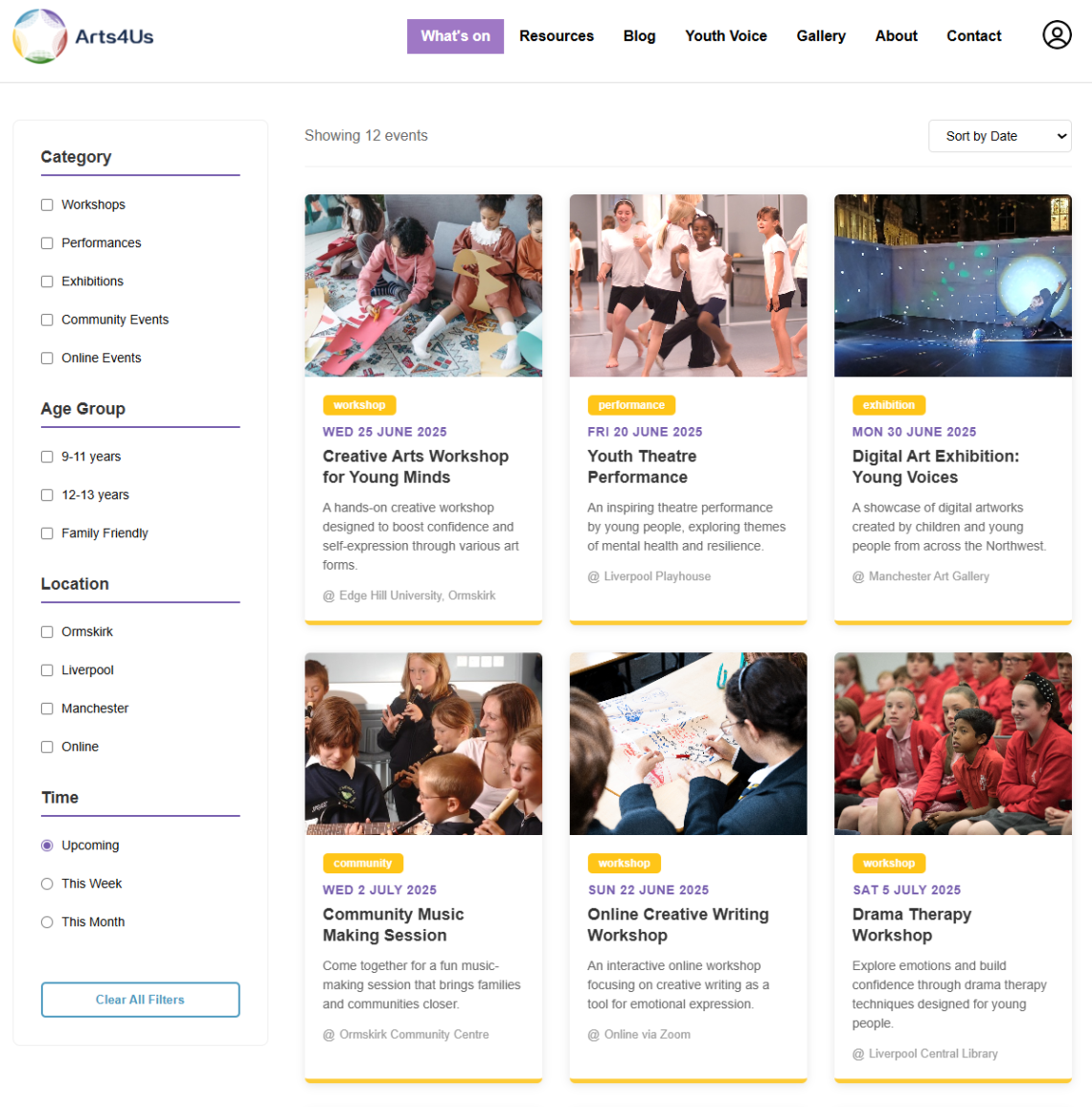
Arts4Us is a £2.5M AHRC-funded initiative led by the Research Centre for Arts and Wellbeing at Edge Hill University. The project is being piloted in the Northwest of England with the intention to progress to national testing. Arts4Us focuses on the mental health of young people aged 9 to 13, a group at significant risk of developing mental health problems during the transition from childhood to adolescence. Arts4Us has developed an easy-to-use digital platform that makes evidence-based local arts activities accessible for children, young people, their families, and relevant organisations. The platform is co-designed with children and young people, who act as co-researchers, to maximise the benefits of arts activities for mental health.
Arts4Us demonstrates the potential of co-designed, evidence-based digital platforms to improve access to arts activities and support the mental health of young people. By integrating research, technology, and cross-sector collaboration, the project offers a scalable, inclusive model for enhancing wellbeing and reducing health inequalities at both local and national levels.
The programme is grounded in co-design, co-production, and participatory arts, with children and young people actively shaping the platform and its content. The methodology includes asset-based approaches, trauma-informed practice, and lived experience leadership. The platform is built on Open Referral UK, ensuring interoperability with NHS and GP systems (e.g., Rio, Paris, Emis Web) and social prescribing platforms (e.g., Joy App, Simply Connect, Access Elemental Social Prescribing). The design incorporates digital innovation, including audiovisual, gaming and AI features to make accessing in-person arts activities attractive and easy for children and families needing mental health support. The platform is informed by extensive research, including umbrella reviews, systematic reviews, economic evaluations, and qualitative studies with children, families, and practitioners (Liverpool et al 2025; Dowlen et al, in preparation; Flynn et al, 2026 under review; Cheung et al 2026 under review).
References:
Liverpool, S., Mc Donagh, C., Feather, J., Uzondu, C., Howarth, M., Bannerman, F., ... & Mateus, C. (2025). Updates on digital mental health interventions for children and young people: systematic overview of reviews. European child & adolescent psychiatry, 34(10), 2961-2974, https://doi.org/10.1007/s00787-025-02722-9.
Dowlen, R., Smirnova, A., Hyland-Broady, K., Cheung, PS., Liverpool, S., Howarth, M., & Karkou, V. (in preparation). Barriers and facilitators to accessing place-based arts activities that support mental health: Understanding children, young people and primary caregivers’ experiences using the Levesque’s conceptual model. To be submitted to Health and Place.
Flynn G, Cheung PS, Moula Z, Fancourt D, Edwards RT, Karkou V (2026 under review). The economic impact of the arts on the health and wellbeing of children and young people: A systematic review. To be submitted to iScience.
Cheung PS, Rhodes, S, Bahr, E, Lakena W, Sajnani N, Fietje N, Karkou V (2026 under review). The effects of the arts and arts therapies on mental health outcomes of children and young people: A systematic review and meta-analysis. Submitted to the Lancet, eClinicalMedicine.
Aims & Objectives
The primary aim is to improve access to arts activities that support the mental health of young people, particularly those aged 9 to 13. Objectives include:
- Enabling collaboration within integrated care systems.
- Making evidence-based arts activities accessible to children, young people, and families.
- Supporting clinicians with research evidence and evaluation frameworks for appropriate use of the arts.
- Reducing health inequalities and supporting early intervention and prevention in mental health.
Outcomes & Measured Impact
The platform is based on extensive research that consists of evidence syntheses (e.g., an umbrella review and meta-analysis on the effects of arts-based interventions for non-communicable diseases; a systematic review and meta-analysis on arts-based interventions on mental health outcomes for children and young people; economic evaluation of the use of the arts on mental health outcomes; a scoping review on barriers and facilitators), interviews and focus groups with children, young people and their families and questionnaires and focus groups with practitioners. This research has fed into the development of the platform alongside an evaluation of existing digital platforms (Chen et al 2026).
Key findings from the evidence reviews showed that arts-based interventions have small-to-medium effects for neurological conditions and medium effects for cancer, cardiovascular disease, mental health conditions, and chronic respiratory disease. For children and young people, arts-based interventions reduced depression and anxiety, and improved wellbeing and quality of life. The platform’s design is informed by young people, parents and key stakeholders as well as economic evaluations and a scoping review on barriers and facilitators to access, ensuring it addresses structural, socio-cultural, economic, and digital inequalities. The project is expected to launch a minimally viable product in early 2026, with a full version ready for national testing by the end of 2026.
Reference:
Chen, A., Smirnova, A., Chen, F., Madu, R., Liverpool, S., Khadjesari, Z., Pereira, E., Trovati, M. and Karkou, V. (2026) ‘The Digital Platform Assessment Matrix: Developing a Framework for Evaluating Digital Platforms and Systems for Children and Young People’s Mental Health Support’, Mental Health and Digital Technologies, 1–22. https://doi.org/10.1108/MHDT-07-2025-0045.
Key Enablers
Key enablers include strong cross-sector collaboration, co-design with children and young people, culturally responsive programming, inclusive practices, flexible delivery models, sustained funding, and the use of digital platforms for accessibility. The platform’s interoperability with NHS and social prescribing systems is a major facilitator for integration into routine clinical practice.
Key Challenges/Barriers
Barriers identified include structural, socio-cultural, economic, physical, psychological, and digital inequalities. Addressing these requires ongoing adaptation, inclusive design, and attention to the diverse needs of users. The project also faces challenges in consolidating evaluation frameworks and collecting case studies from diverse local assets.
Demographics, Settings & Referral Routes
Demographics: Currently the Arts4Us targets children aged 9 to 13 years with the goal to scale for younger children (6–12), adolescents (13–17), young adults (18–25), and intersectional groups.
Settings: The platform is designed for use in mental health hospitals, primary care, community health hubs, allied health settings, community centres, schools, libraries, museums, theatres, faith settings, youth clubs, sports centres, outdoor spaces, homes, and online.
Referral Routes: Participants can access the platform via self-referral, primary and secondary care, local authority pathways, neighbourhood health centres, community connectors, digital referral platforms, word of mouth, community noticeboards, social media, event outreach, research trial advertisements, education and specialist pathways, cultural venues, faith-based groups, charities, and public health campaigns.
Evaluation Methods
Evaluation methods include routine monitoring data, validated outcome measures (e.g., WEMWBS, EQ-5D, PHQ-9, GAD-7), participatory and co-produced evaluation, case study and narrative evaluation, market research, formal internal evaluation, and independent research. Extensive qualitative research is planned for 2026 to consolidate the evaluation framework used in the study and to collect case studies from diverse local assets providing different forms of arts and arts therapies to children and young people in different settings.
Participant & Stakeholder Feedback
Feedback from children, young people, and families highlights the importance of arts activities for self-expression, emotional regulation, and social support. A vignette from an 11-year-old CAMHS service user illustrates the transformative impact of arts engagement, with both the child and his mother emphasising the value of creative activities and supportive peer groups for mental health and wellbeing.
"M is an 11-year-old boy who is a CAMHS service user in the North West. M has a love of musical theatre, especially Hamilton, and is the proud owner of a bearded dragon. His mum told us he often ‘freezes’ or becomes ‘mute’ in new or overwhelming situations, or tics more strongly than usual. The traffic on the way to the workshop was bad which meant M chose not to speak during the workshop. After the workshop M stated “I have found my voice” and decided to share his experiences of the workshop in a one-to-one interview. We talked for 30 minutes.
His mother stated: "At home, he'll do a lot of colouring in and writing. He likes writing his own stories and only using himself in…He’ll sit and colour…he’ll have his bearded dragon on him at that time, and he’ll sit and colour with the bearded dragon just to calm down. [...] [The Musical Theatre Group] a place he can be him, and the group of children he's with haven't judged him at all. They're just sort of taking it in their stride that sometimes he'll shout out different things in the places where he probably shouldn't, but they just all support him. So, I think it's somewhere he can be him and be supported."
Alignment with National Strategy & System Learning
Arts4Us aligns with national strategies for digital technology, evidence and impact, health inequalities, health and care settings, and planning and commissioning. The platform is interoperable with NHS and social prescribing systems, supporting integration into clinical and community practice. It contributes to system learning by providing research evidence, evaluation frameworks, and case studies to guide clinicians and policymakers.
Further information:
https://tekchok25.github.io/arts4usdemo/
Image: The Arts4Us platform
This Case Study was submitted as part of a call out for Createch Case Studies, and demonstrates good practice in digital innovation within creative health.
Innovation & Digital Transformation
Arts4Us exemplifies digital innovation by creating an interoperable, evidence-based platform that integrates with NHS and social prescribing systems. The use of AI, gaming, and audiovisual features enhances accessibility and engagement, making arts activities more attractive and less threatening for children and young people.