
Screen-based Artworks at Chelsea and Westminster Hospital and West Middlesex University Hospital
Delivered by CW+ (The official charity of Chelsea and Westminster NHS Foundation Trust)
Funding: CW+
Overview
Screen-based digital artworks have become a central feature of the art collection at Chelsea and Westminster Hospital (CW) and West Middlesex University Hospital (WM), overseen by CW+, the official charity of Chelsea and Westminster Hospital NHS Foundation Trust. The collection includes over 2,000 artworks, with digital commissions from Royal College of Art graduates, emerging and established artists, and world-renowned figures such as Brian Eno and Isaac Julien. The programme aims to enhance the hospital environment for patients, staff, and visitors through innovative, interactive, and nature-inspired digital installations, including “Birds on a Wire,” (by Random Quark), “Flow,” (by Zheyuan Zhang and Studio Inneract), “The Breeze Outside,” (by Zheyuan Zhang and Studio Inneract), and the RELAX Digital series (by a range of artists).
Approaches & Methodology
The programme employs a holistic, whole-person care approach, integrating healthcare innovation and digital technology. Artworks are designed to be interactive, responsive to environmental conditions, and reflective of the outside world. For example, “Birds on a Wire” invites engagement with virtual birds that react to user interaction and real-world weather, while “Flow” and “The Breeze Outside” use motion sensors and environmental data to create calming, personalised experiences. The RELAX Digital programme features moving imagery and installations across hospital screens, providing continuous, accessible art. Evaluation combined routine monitoring, surveys, and narrative feedback from staff, patients, and visitors.
Aims & Objectives
The primary aims are to:
- Enhance the hospital experience for patients, staff, and visitors through digital art.
- Provide moments of calm, distraction, and engagement in clinical environments.
- Support psychological healing and wellbeing by connecting users with nature and creative expression.
- Evaluate the impact of digital artworks on mood, engagement, and perceptions of the hospital environment.
Outcomes & Measured Impact
In total, 111 surveys and short interviews were completed across CW and WM: 46 with staff and 65 with non-staff (including patients and visitors). Quantitative data underwent descriptive analysis, while qualitative data was analysed using thematic and framework analysis.
Results showed widespread enthusiasm for digital artworks, with 47% of RELAX Digital viewers preferring screen-based works over traditional artforms. “The Breeze Outside” was found to be calming by 93% of viewers, and 64% reported a positive influence on their ward experience. Interactive works like “Flow” and “Birds on a Wire” were described as fun and engaging, especially for children, with 80% of respondents willing to interact again.
RELAX Digital works saw some of the highest levels of engagement, perhaps due to their positioning in waiting areas, so longer exposure to RELAX Digital works correlated with higher enjoyment and relaxation, and nature-based content was especially valued. The programme demonstrated cumulative positive effects on mood and comfort, particularly for those with longer waiting times.
For example, data from the RELAX Digital surveys could be broken down by both the waiting time of the viewer and their answer to the question “How important do you think the arts are in contributing to the experience of the patients and families in hospital?”. For outcomes relating to the impression of the artworks on the viewer (such as liking the content, or feeling relaxed while looking at it), there appeared to be a cumulative positive effect over time, which is independent of the viewer’s attitude to the arts. For example, while 44% of people waiting up to 14 minutes agreed that they liked the content of the video artworks, this rose to 88% for those waiting 30 minutes or longer. One explanation of this may be due to a greater variety of different video pieces being viewed over a longer time period.
For outcomes related to the “presence” of the artworks (such as making time pass more comfortably, or improving mood), those who placed the most importance in the arts did tend to report stronger agreement, as well as those waiting longer. This might suggest a broad positive impression of the works for those with the longest waits, while sustained environmental benefits may be felt more by those who place importance in the arts more generally.
Key Enablers
- Integration of digital innovation and healthcare design.
- Strategic placement of artworks in high-traffic and waiting areas.
- Collaboration with leading artists and art institutions.
- Responsive, interactive, and nature-inspired content.
- Ongoing evaluation and adaptation based on user feedback.
Key Challenges/Barriers
- Technical complexity and maintenance requirements for interactive installations.
- Need for clear signage and instructions to maximise engagement.
- Ensuring accessibility and relevance across diverse hospital users.
- Sustaining engagement and managing operational demands in busy clinical settings.
Demographics, Settings & Referral Routes
Demographics: The programme serves patients, staff, and visitors of all ages and backgrounds in acute hospital settings, including general wards, specialist units, and waiting areas.
Settings: Interactive and screen-based artworks are accessible throughout Chelsea and Westminster Hospital and West Middlesex University Hospital in North West London.
Referral Routes: Participants in the evaluation were recruited through direct engagement in hospital settings, with surveys and interviews conducted among staff, patients, and visitors who viewed or interacted with the artworks. The programme is promoted through hospital communications and the CW+ network.
Evaluation Methods
A formal internal evaluation by CW+ used surveys and interviews to capture both quantitative and qualitative feedback, ensuring ethical engagement and participant consent.
Participant & Stakeholder Feedback
Regarding the interactive works, 26% of viewers of “Birds on a Wire” and 25% of viewers of “Flow” directly commented on the works being fun or enjoyable. One respondent said “Birds on a Wire” had made them smile, adding that this is “what you need in a hospital”, while a staff member described how interacting with “Birds on a Wire” after finishing a shift was a kind of stress relief. Viewers of “Flow” complemented the movement and colours, describing it as calming and soothing to watch.
Overall feedback is overwhelmingly positive. Viewers described the artworks as calming, relaxing, and enjoyable, with particular appreciation for nature themes, colour, and movement. Interactive works were seen as fun and stress-relieving, especially after challenging shifts. However, it was noted that these more technically complex works required more maintenance, as well as clear signage to indicate that they were interactive and how to use them. Some also commented that such works may get the most engagement in paediatric settings.
Alignment with National Strategy & System Learning
The programme aligns with national strategies for digital technology, evidence and impact, and health and care settings. It demonstrates how creative, digital, and participatory approaches can be embedded in clinical environments to support wellbeing, patient experience, and system learning.
Further information:
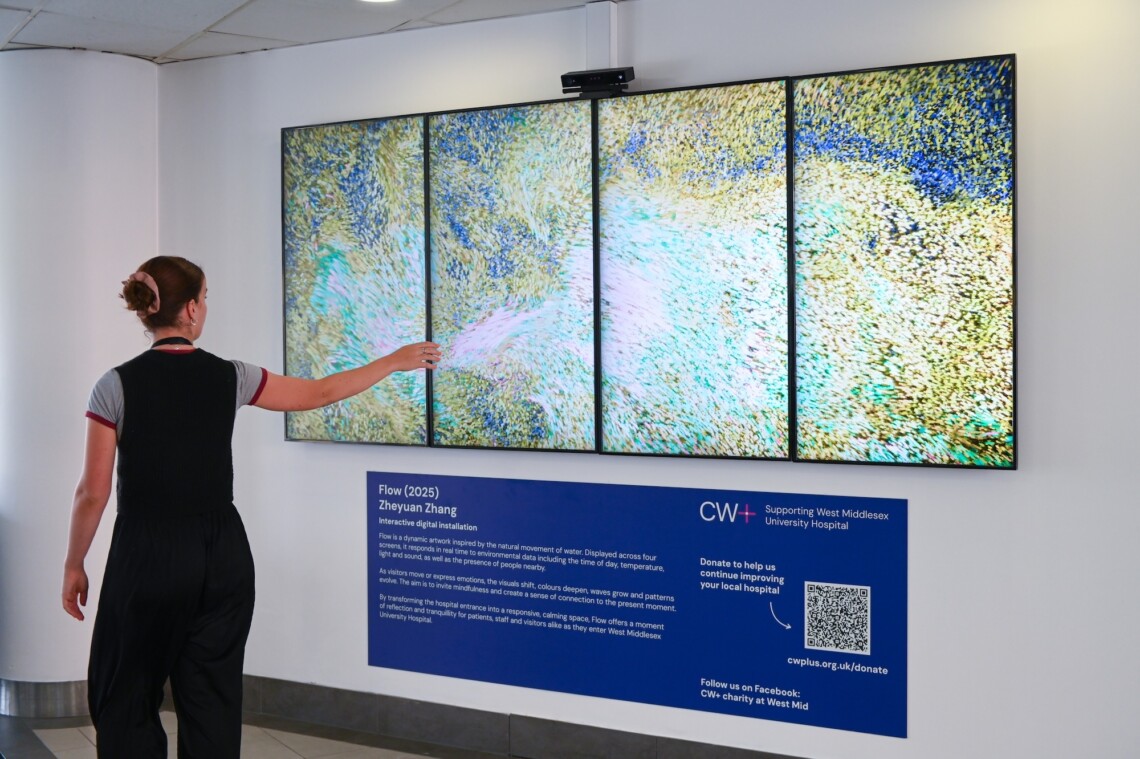
The title of the piece pictured is "Flow" by Zheyuan Zhang. Image © CW+
This Case Study was submitted as part of a call out for Createch Case Studies, and demonstrates good practice in digital innovation within creative health.
Innovation & Digital Transformation
Screen-based digital artworks at Chelsea and Westminster and West Middlesex University Hospitals demonstrate the transformative potential of creative technology in healthcare. By enhancing mood, comfort, and engagement, the programme offers a replicable model for integrating digital arts into hospital environments, supporting patient and staff wellbeing and advancing system-wide innovation. The programme exemplifies digital innovation in healthcare, using apps, online platforms, VR/AR, and responsive installations to create immersive, healing environments. The integration of real-time environmental data and interactive technology sets a precedent for future digital arts in clinical care.