Connecting Through Creative Practice: Reflections from Two GP Creative Health Special Interest Group (SIG) Study Days.
Background
The RCGP Special Interest Group for Creative Health had its first meeting in 2021. It is support by both the RCGP and NCCH and has a growing membership. Most members have a background in General Practice, but the SIG also welcomes allied healthcare professionals working within Primary Care and medical students.
The GP Creative Health SIG aims to:
- Inspire whole-person care through the arts.
- Embed creative enquiry across education, practice, policy and research.
- Reflect, connect and flourish together.
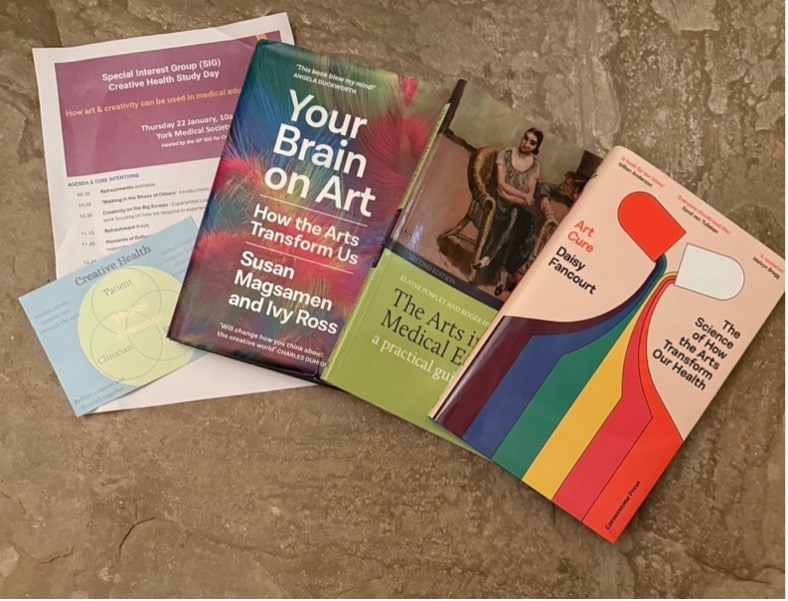
These aims support the human dimension of medical care as shown in the infographic on our GP SIG postcard. Find out more here >> https://ncch.org.uk/gp-sig-for-creative-health
The GP Creative Health SIG is evolving and exploring ways of supporting members and developing strategy to promote wider inclusion of creative health in education, practice and policy. In-person study days in both London and York play a key role in connecting members and providing a space to learn together and to share creative practice. I remember the first time I attended a study day. I travelled up to London, I knew no one in the room and felt anxious that my work using art and creativity would be seen as something quirky and frivolous. I should not have worried. I left feeling connected and supported, with renewed enthusiasm that what I was doing was important and mirrored the work of colleagues around the country. I felt I had found ‘my tribe’ of people using the arts and creativity in their medical and personal practice.
Planning for the next two study days is underway, so it feels appropriate to look back and write a blog to record the key elements of the last two events. I hope that this may encourage new members to attend and contribute their work and ideas.
Our last two study days took place on Friday 21st November 2025 at Lumen in London, and Thursday 21st January 2026 at York Medical Society in York. Thank you to everyone who attended the events and contributed their experience and perspective. Rather than make a complete record of the programme I have tried to capture the essence of the events. We will aim to make a more complete and contemporaneous record of the next two events to share with participants and anyone who is unable to attend.
London
The day was attended by members of the GP SIG along with representatives from the NCCH and the Nursing Creative Health SIG.
Our key themes were:
Land, connect, remember why we’re here
The study day was led by Louise Younie who set the scene for the day by describing the concept of Flourishing Spaces. She gave everyone in the room time to introduce themselves to the group and to share how they express ‘creative health’ in their work or personal practice. Each person who attended was invited to bring or share a small object, image, or poem line that represents their work in primary care. These were shared and woven into the discussions of the day.
Participants shared a wonderful range of creative activity and raised many questions which included:
- How do I validate my work.
- How do we/I embed creative health in practice across the country.
- How do I connect with others in this field.
Mapping the movement - make visible the existing ecosystem
I noticed participants often underplayed the value and importance of their work/creative practice by using the words ‘just’ and ‘only’. We agreed it is hard to be confident about work in creative health when the concept is not understood and the benefits for its use in education, patient care and human flourishing are not appreciated and valued by all work colleagues and learners.
It was evident from people’s stories that creative health is an umbrella term that encompasses using art and creativity in three areas:
- For human flourishing (creative enquiry with students and clinicians)
- To improve patient health outcomes
- In medical education
Visioning the Possible - Imagining the future we wish to seed
Nicola Gill shared examples of how art can help us imagine possible futures. One example shared was E. M. Forster’s1909 novella, The Machine Stops where a communication tool similar to Zoom was imagined and described by Foster and used by the lead characters to connect in a world that had been destroyed by climate change. Forster would have been amazed to see technology (Zoom and Teams) enable people to remain connected during the COVID 19 Pandemic.
This set the scene for small group discussions based around three questions
- What might it look like to have ‘creative health’ woven through primary care- in patient care and medical education?
- What are the obstacles and enablers for this to happen?
- What one realistic transformation would you like to see happen in the next year? (what might enable this to happen?)
The themes that arose in discussion were broad. They varied from individual development needs: to gain confidence, find local collaborators and identify appropriate resources; to wider strategic ideas about influencing political policy and educational curriculum content. The themes were captured and considered at future SIG leadership meetings.
Experiential creative flow space
Linda Miller introduced participants to ‘zines’ - a DIY, self-published pamphlet or magazine. She shared how she uses these in creative wellbeing sessions with doctors at all stages of their medical careers. Very quickly we were all ripping, cutting and sticking to make a zine that reflected something about our world and life. I loved the zine a colleague created about her hyperemesis.
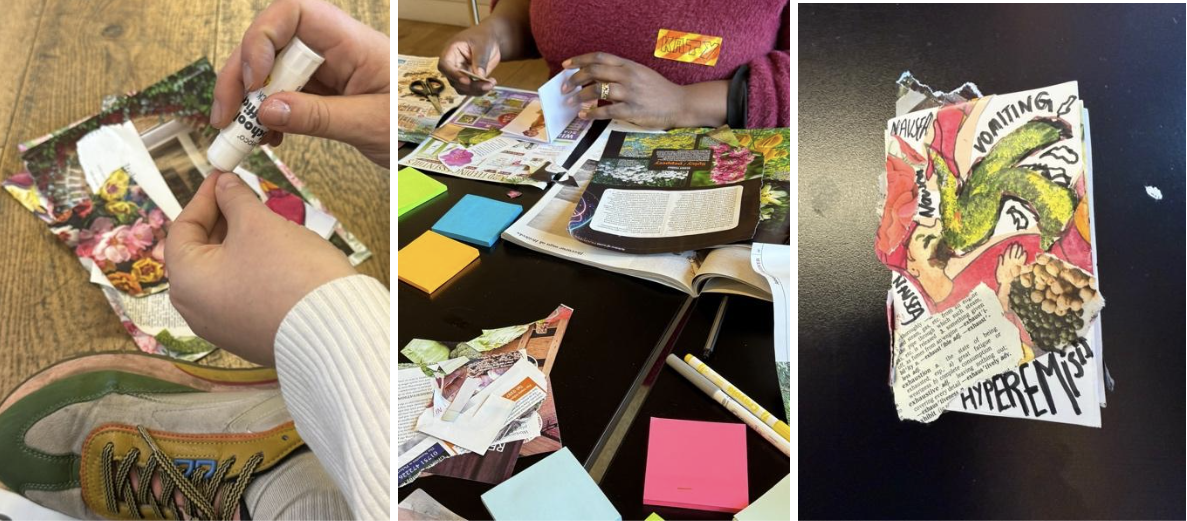
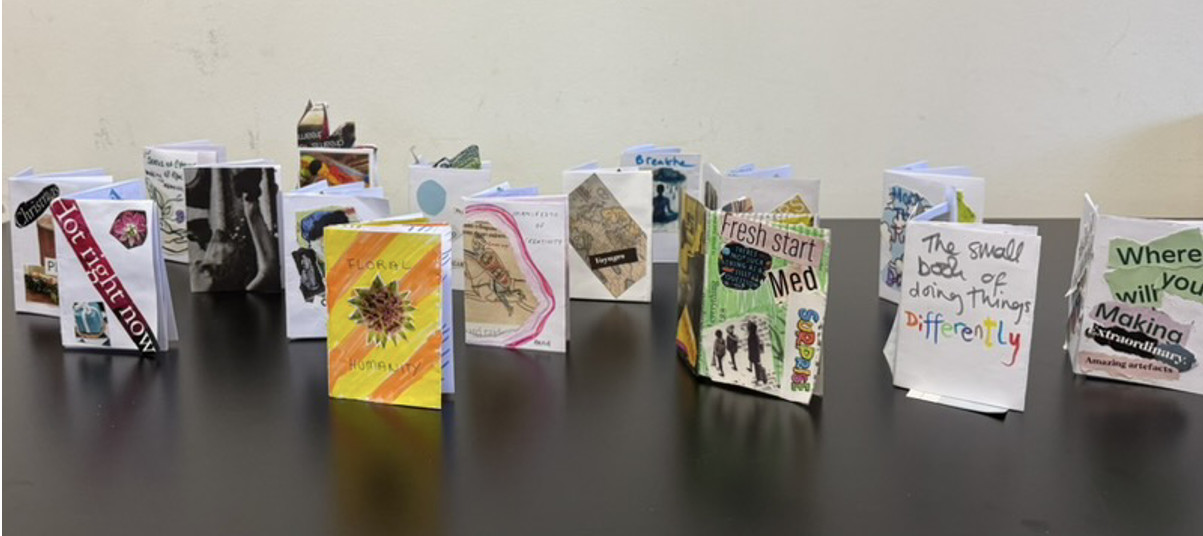
Zine Haiku
Sitting quietly
Ripping words from magazines
Creating ideas
We also heard the beautiful voice of Grace McGeoch, a GP in London. Grace told us all about the Singing Mamas project she has worked with.
Closing Circle: Harvest insights and commitments
There was a warm and generous sharing of ideas for how to nurture the growth of creative health on a personal, organisational and societal level. Take-home messages included ideas for small changes people might make to their creative practice. Suggestions for how the SIG might support members were captured and are shared in the final section of this blog.
York
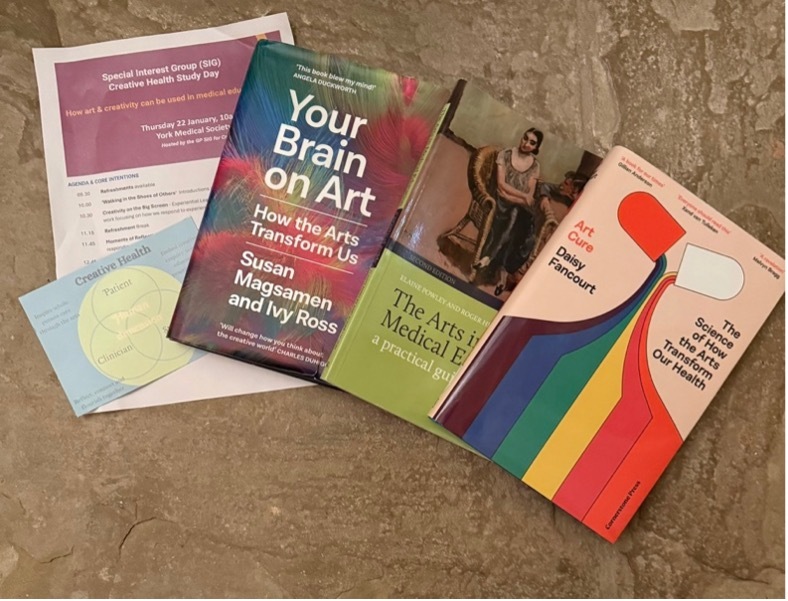
The study day in York focused on how art and creativity can be used in medical education.
We invited GP SIG members and other professionals involved in using art and creativity in medical education to bring their expertise, experiences, joys, challenges and questions to York.
Our main themes of the day included:
Walking in the shoes of others
As an icebreaker, we introduced ourselves with reference to the shoes we were wearing, Participants did this in a variety of ways, some chose to share the story of the shoes, other people talked about the reason they decided to wear that pair of shoes. This idea arose from a project called A Mile in My Shoes. Through this we discovered that our participants came from a wide group of professionals mainly with a background in GP, but also included a pharmacist, a hospital artist, and an architect working in academic teaching who wanted to ensure her students consider the human dimension in their work.
Creativity on the Big Screen
We watched two short films ‘Plunge’ directed by Ellie Land and produced by Tyke Films and ‘The Evening Thread’ produced and directed by Iris Moore and used these as catalysts for discussion about how we use art and creativity in medical education. Both are wonderful short films to use in teaching and are available online.
Moments of reflection
The day included time for participants to reflect on their work and create something in response to our discussions.
Participants cut and stitched and glued, and some wrote Haikus.
Seeds, dropped from the wing,
Carried on the wind, fall, land,
Dare to send out shoots
By Amyas Bray GP and Trainer in Yorkshire (written in response to Iris Moore’s short film)
The GP Window. A Haiku.
(For GPs who like to look at the sky during their working day)
Think. Describe. Prescribe.
The sky infinite, changing
Permission to feel
By David Hopes, GP and Educator in Plymouth
Download David's Haiku here for your surgery pinboard >>
Using art and creativity in medical education
Many special interest groups create a toolkit to help inform colleagues and support them in their work. In the afternoon session we explored how we might best encourage and support colleagues to use more art and creativity in their teaching.
Our discussions were based around these questions
- Can we define what art and creativity in medical education is and what it does?
- How might we encourage its wider use?
- What are the enablers and obstacles?
- Can we create a framework or top tips list to support its use?
Hearing their wisdom of experienced educators, acquired through years of experiential learning was inspiring. Thank you, Linda Miller, Niro Amin, Louise Younie, and Alexis Payne.
We also heard from participants who were just starting out on their journey of using art and creativity in their teaching. They said they needed courage to open conversations in medical education using art. I realised I had forgotten how much bravery I needed when I first started 25 years ago, and how fearful I was of the feedback and potential for disparaging remarks from colleagues.
Alexis Payne suggested using the concept of a tool box as a container for the ideas that arose from our discussion. So here is a list of Top Tips for your Creative Health Tool Box. These are skills we use every day in General Practice.
TOP TIPS for your Creative Health Tool Box
Using art and creativity in medical education requires:
- Courage
- Good listening skills
- Curiosity and being open to challenge
- Good facilitation skills
- Gentle confidence rather than artistic expertise
- Emotional intelligence
- The support of a co-facilitator
When using art and creativity in education:
- Remember why you are using art and creativity
- Plan your session using good educational practice
- Consider the environment
- Build personal connections in the room
- Set the scene and the context for learning.
- Create psychological safety (learn how to hold the room)
- Expect the unexpected
- Reassure learners that they are not expected to have any artistic expertise, just a curious and open mind.
Remember the ‘art and creativity’ are the catalysts for learning, team building and reflective activity not the focus of the learning.
Read more about using art and creativity in medical education here.
Those of us organising the days appreciated the generosity with which participants shared personal stories and ideas, there was a warm supportive feel to the room.
‘It was a fascinating day’
‘A really rich and inspiring day’
'I thank you all for bringing light to a difficult week'
Actions arising from the GP Creative Health SIG Study Days
Participants said they found it hard to remember when SIG or other Creative Health events were happening and wanted a way to promote their own local and national creative health events.
The GP SIG now has a Team Up Calendar, administered by Grace McGeoch. Information about access to the calendar and details of how to submit events is available on the NCCH website.
Participants said they wanted more information about how art and creativity are used in the three areas mentioned above. And participants said they wanted opportunities to connect with colleagues in the SIG.
The GP SIG has just started a programme of monthly online webinars. This combines a recorded ‘educational’ section with time to connect with SIG members in small groups.
There will be two study days each year, London and York, with the potential for events in Wales and Scotland.
The GP SIG is also looking at the Toolkits developed by other RCGP SIGs and considering what might work best for our SIG members.
Participants said they wanted more information about the GP SIG to be available on the website.
The SIG information page on the NCCH website has been updated and can be accessed from the RCGP Creative Health SIG webpage.
We look forward to welcoming members to our next two study days, 27th November 2026 in London and 18th June 2027 in York. Information with an invitation to book will be send out on email and posted on the Team Up calendar.
The Study Days are supported by the NCCH, but we ask participants to pay a small charge to cover the hire of the room and provide hot drinks. To keep costs down we invite participants to bring their own lunch.
If you have suggestions for our next two study days, please email Alexis Payne and she will share these with the Leadership Team.
Written by Nicola Gill, GP Creative Health SIG Vice-Chair