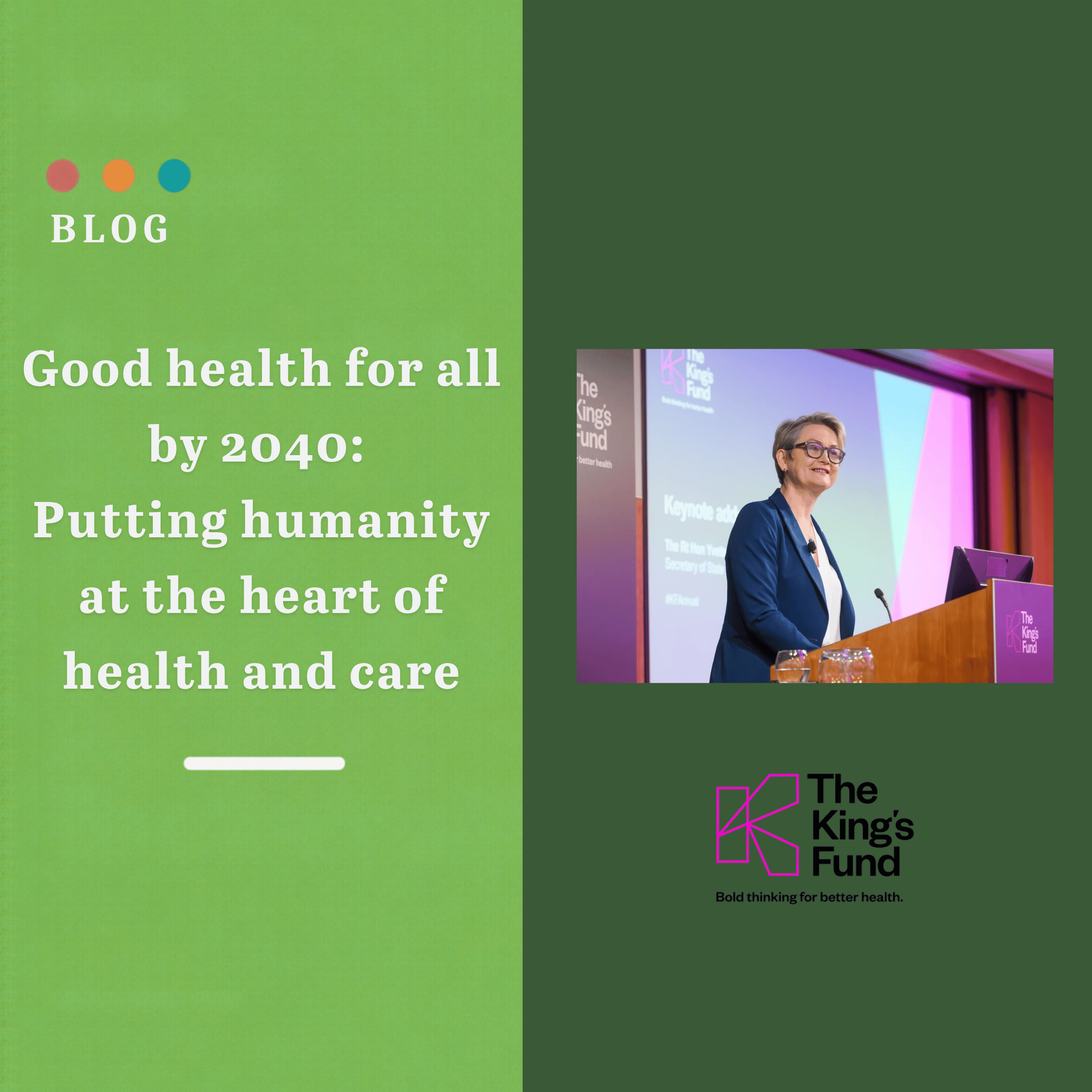
Good health for all by 2040: Putting humanity at the heart of health and care
Date: Tuesday, 24th November 2026
By Jayne Howard - Head of Programmes
I came away from the King’s Fund Annual Conference feeling both challenged and encouraged.
Over two days, speakers explored the theme of Good health for all by 2040, considering what needs to change in a world characterised by increasing complexity and uncertainty – from the climate crisis and geopolitical instability to the rapid development of AI – and there was a strong sense that the future will require radical thinking and new approaches to how we organise and deliver health and care.
There were lots of interesting discussions, but three things particularly stayed with me: the importance of taking action on the determinants of health, the need for open and honest conversations, and, above all, the importance of humanity in health and care.
Thinking at a systems level
I was particularly struck by the emphasis on thinking and working at a systems level, which is an approach we are taking in our Creative Health Leads programme. We know that health is shaped by so much more than the services provided by the NHS. It is influenced by our relationships, our communities, our environments and the opportunities we have to live fulfilling lives.
If we are serious about achieving good health for all, we need to get better at joining things up, looking beyond organisational boundaries and recognising the contribution of a much wider range of partners. This means moving beyond simply changing individual services towards thinking differently about the whole system and the conditions that enable people and communities to thrive.
This resonates strongly with the principles of creative health – the growing recognition of the role that arts, culture and creativity can play in supporting health and wellbeing, preventing ill health and addressing inequalities.
The conversations we need to have
The challenging global context and the pressures on the national economy make it increasingly important that we think differently about how health and care is funded, organised and delivered.
This calls for open and honest conversations about the choices we face, the resources available, what needs to change and, crucially, what matters to people themselves. Patients and the public need to be active participants in these conversations, rather than simply being presented with decisions that have already been made.
The shift from doing things to people to doing things with people - from ‘power over’ to ‘power with’ as one speaker put it - feels fundamental to the transformation we need. Creative approaches can help make this shift a reality, moving beyond traditional consultation methods and using arts and creativity to explore people's experiences, build a deeper understanding of the challenges and open up new possibilities for solutions.
Keeping humanity at the centre
Most striking over the two days was the focus on the human. Coincidentally, ‘human’ was named the Cambridge Dictionary’s word of the year on the first day of the conference which felt particularly appropriate.
Amid all the discussion about innovation, system reform and technology (particularly AI, which featured heavily over the two days with conflicting views about its potential for good or ill), we were reminded of the importance of human-to-human connection – the relationships between health professionals and patients, the connections that sustain us in our communities and the simple importance of feeling heard, valued and understood.
Creative health offers opportunities to build connection, belonging and agency, often in places and spaces beyond traditional health settings. It can help create the conditions for healthier neighbourhoods, bringing people together, strengthening communities and connecting health services with the wider assets that support wellbeing.
It also has an important contribution to make across different stages of life. For children and young people, creative approaches can provide routes to expression, connection and emotional support, particularly at a time of increasing concern about mental health.
For older people, including those living with frailty or in care homes, creative activity can support identity, social connection and quality of life. These are not optional extras but important dimensions of person-centred care.
What this means for our work
Two things I took away from the conference:
- We need to think and act differently, together. Better health will not come from the NHS working harder in isolation. It requires a whole-system approach that values communities, partnerships and the wider determinants of health. Arts, culture and creativity have a role to play in prevention, mental health, social care and supporting healthier communities.
- We must keep humanity at the centre of our thinking. Transformation should not just be about structures, processes and technology. It should be about people, relationships, lived experience and what enables us to live well.
I also particularly liked Pedro Delgado's challenge to Dare, Partner, Ignite:
- Dare to do things differently and do different things;
- Partner by sharing power and working with others, respecting and valuing all contributions;
- Ignite change by keeping our own enthusiasm alive and helping to inspire and enable others.
The conference provided valuable opportunities to explore different models for funding, organising and delivering health, care and welfare services. While there were differing views about what these models might look like, there was a clear consensus that significant change is needed.
The development of more integrated, neighbourhood-based health and care services, with a focus on maternal health and the early years, young people experiencing mental distress, and frail older people (as outlined by the Secretary of State in her speech to the conference) offers a significant opportunity to embed creative health in new ways.
If we are serious about achieving good health for all by 2040, perhaps one of our starting points should be to remember what makes us human – and to build a health and care system that truly reflects that.