p_ART_icipate: APHG Report and Recommendations Mapping Pathways for Digital Creative Health
Guest Blog written by Oliver M. Gingrich, Associate Professor in Animation, University of Greenwich on behalf of p_ART_icipate
Digital Creative Health
Digital Creative Health refers to digital participatory creative applications delivered through digital tools such as participatory creative online applications, sensor-based platforms, immersive experiences including virtual or augmented reality, and AI-assisted apps, which support health and wellbeing. There is growing evidence that digital participatory arts support mental and physical health, and digital delivery can widen access for people held back by distance, mobility or isolation. Further evidence has been provided by the p_ART_icipate research group (www.participateresearch.co.uk) which focuses on ethical and accessible design and facilitation of digital participatory applications. This focus moved towards the centre of political debate within the context of the 10-year Health plan.
The p_ART_icipate consortium
p_ART_icipate is a multi-sector consortium which advances digital creative health through participatory arts, promoting ethical, accessible and inclusive frameworks for digital participatory arts through research, practice and policy recommendations. We bring together expertise from participatory arts, the NHS, public health, research, XR and immersive technologies, community practices, and lived experience.
The consortium supports the national conversation around the implementation of the 10-year Health plan for England, particularly its three strategic shifts: ‘from hospital to community, from analogue to digital, and from sickness to prevention of ill health’. We share a values-led approach focused on how these practices are led by co-creation, participatory practices, safe spaces, acknowledgement of authorship, co-design, accessibility inclusion, co-production, ethics and accessibility.
Regulatory context
This emerging field sits at the intersection of three live policy agendas. The NHS 10-Year Health Plan places digital transformation and the shifts from hospital to community, analogue to digital, and sickness to prevention at its centre. The Data (Use and Access) Act 2025 (DUAA 2025) introduces new data governance requirements but does not address creative health data. Reform of the NHS workforce and the move towards neighbourhood health create an opening to embed creative health in community provisions, which the consortium advocates for.
As we know, the sector is innovating rapidly, yet it has no defined home in regulation, or in any single government department. Adoption pathways for digital applications are cumbersome, costly and not always fit for purpose. As a result, promising tools and innovations often struggle to reach the patients and communities who could benefit.
APHG recommendations
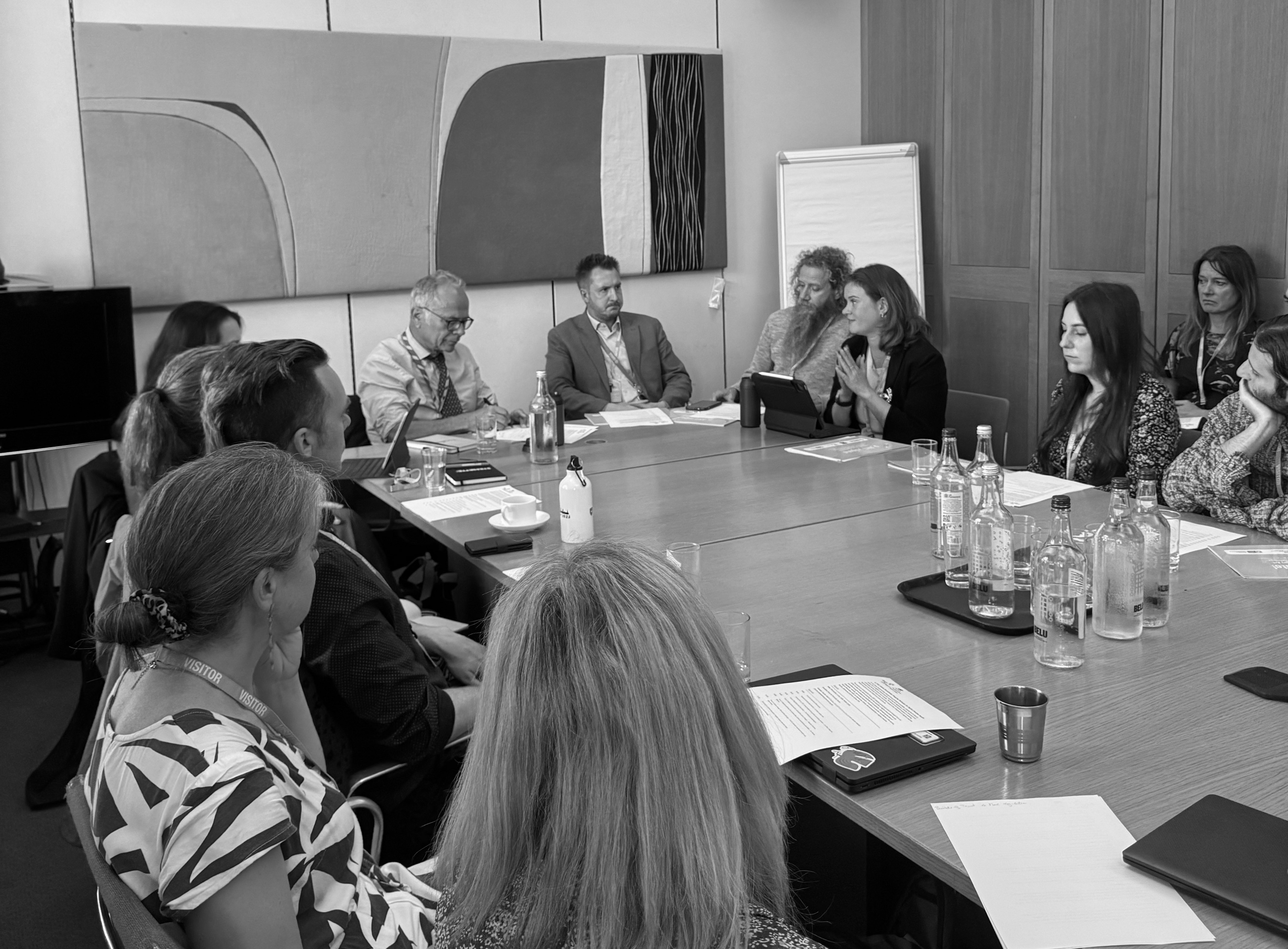
Building on four parliamentary recommendations developed by the National Centre of Creative Health (NCCH) following the All-Party Parliamentary Group for Creative Health (APPG) and their roundtable in April 2026, the consortium convened a follow-up conversation supporting the NCCH’s policy recommendations. This policy briefing was developed as part of a roundtable held by the p_ART_icipate! consortium in collaboration with the All-Party Parliamentary Health Group (APHG). The session brought together representatives from across research, the NHS, the arts, technology, and people with lived experience of using these services, to map the barriers and identify practical actions. It builds on an earlier roundtable in November 2025 on standards, ethics and accessibility, and was structured around four themes:
Regulation and data ethics; digital infrastructure, accessibility and co-design; adoption pathways for communities, practitioners and small and medium-sized enterprises (SMEs); and culture change, higher education institutions and the skills gap.
1) Regulation and Data Ethics
There is no regulatory oversight for creative health data. As people take part, these tools continuously capture sensitive information about their bodies, behaviour and emotional state, often in group settings and sometimes involving vulnerable people. This data falls between clinical regulation and consumer wellbeing rules and is not covered by the DUAA 2025. Combined, it can identify a person more precisely than a passport, yet there is no model for who owns data generated by a group, and no government department has clearly taken responsibility.
2) Co-design is currently treated as a tick-box, not a condition.
Designing services with the people who use them (“co-design”) is widely endorsed but rarely required. Genuine co-creation involves many contributors, yet data and AI law assume a single individual. Communities are too often brought in only at the end, and small grassroots organisations lack the resources to navigate co-design and funding processes.
3) NHS structures are not built to receive digital creative health innovations.
There is no clear way in and no single body responsible for adopting them. Because the approval routes were designed for pharmaceutical trials, a small organisation can face costs reaching £2 million and timelines of up to ten years to bring a product into NHS use. Specialist professional associations and regulated arts therapies workforce already exist. What is missing are clear adoption and governance pathways for digital creative health across NHS, community and voluntary-sector contexts, which needs to include coordination between clinical and non-clinical creative health provision.
4) Evaluation frameworks fail to capture what the work does.
The standard ways of measuring health outcomes do not capture much of what these activities achieve: how people make sense of their experience, changes in relationships, and the effects of working in a group. Projects assessed only on individual outcomes have repeatedly lost their funding as a result.
p_ART_icipate Summary Report and Recommendations
The p_ART_icipate roundtable Summary Report has now been published including Parliamentary recommendations by the NCCH and the p_ART_icipate consortium can be accessed here: